


This article was updated on March 11, 2026 with an up-to-date FAQ section.
[LAUNCH] SalesWings provides true 360° Customer Journey Tracking. Identify, follow, score and profile leads based on their digital interactions with your business from more than 1000 web applications
In summer 2018, SalesWings and our valued clients have passed a significant milestone: Over 10’000’000’000 (10 billion) lead website and email interactions have been tracked and scored in real-time to enable timely and personal customer interactions.
With our most recent release our clients can now track, score and create profiles (segments) based on their leads’ activities with their entire sales and marketing software stack. By mid 2019, SalesWings will have collected a rich and powerful data set of over 100 billion lead interactions to boost our technology’s further development.

.
The SalesWings Philosophy
Let’s imagine: Your website is a physical store. Wouldn’t it be easy to see when a lead is interested, and what they look for? You would know directly in which area of the store they’ll spend time. Which brochures they take. What screens they look at. Their behavior would be your main weapon to advise them personal and timely.
Well, the modern buyer’s decision making has become digital. Our business environments are virtual. SiriusDecisions, one of the world’s most prominent research firms in the sales and marketing space estimates that buyers today conduct 67% of their buying journey online; hidden, and anonymous.
In 2014 we have set out to build the world’s most clever, user friendly, cost-effective and innovative lead scoring platform for modern sales and marketing organizations – and we have achieved. Clients on all 5 continents, from more than 35 countries, and in dozens of industries, are leveraging today SalesWings to benefit from advanced lead scoring and lead engagement tracking in a flexible way.
Our client’s business challenges are tightly aligned with our value proposition:
- Qualify and prioritize any number of email marketing, inbound and sales lead
- Get real-time insights into lead behavior, interest and sales-readiness
- Enable their sales team to control volatile buying cycles and “silent buyers”
- Personalize their lead’s sales experience based on a lead’s true desire
- Building and automating workflows amongst multiple applications
- Better align their sales and marketing teams to work more effectively
- Enhance sales response rates, increase lead qualification rates and close rates
- Accelerate sales cycles
- Increase close rates of low performing sales reps
.
SalesWings multiplies its tracking and scoring capabilities today
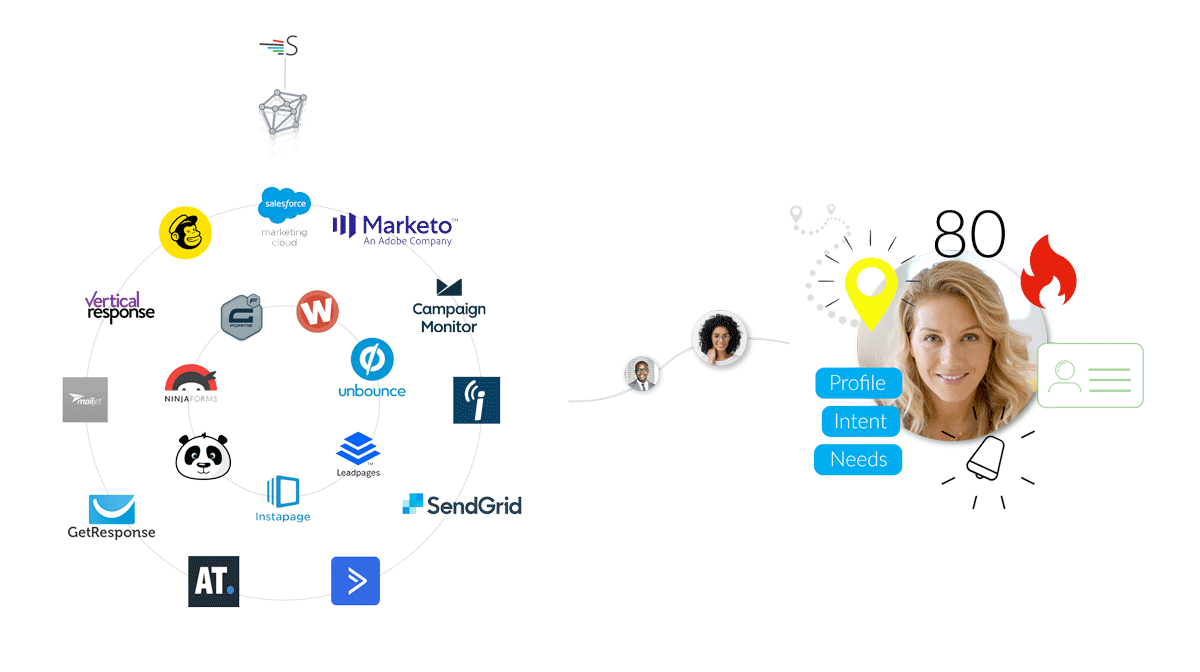
Our clients can now centralize detailed lead engagement from over 1000 sales and marketing applications, by receiving their interactions in real-time through our API. All these interactions can be used by our advanced lead scoring and lead intent profiling solution to serve your customers more timely and in a fully personalized way.
A modern sales and marketing stack consists of a wide set of tools that leads interact with. According to Workato, the average enterprise organization now uses over 1935 business applications (!), with a certain portion being customer facing. Over 5000 sales and marketing tools are used to engage leads. Centralizing lead signals and interactions from various applications is key to get a 360° view on each customers buying intent and life cycle stage. Here are a few examples what you can now do with SalesWings:
Deep tracking of any on-page website engagement
Saleswings now allows you to tag detailed website engagement based on your requirements by ingesting data from Google Tag Manager, Tealium and other tag management solutions. You can use these engagements to refine your scoring and get a more accurate measure on who the most sales ready leads are. Furthermore, certain lead activities (such as video views) are interesting insights that you may want to provide to your sales team.
Examples include:
- Scroll depth; understand how far leads scroll down on web pages or landing pages. Particularly interesting for long pages to understand the depth of a lead’s interest.
- Funnel or shopping cart drop out; understanding when leads abandon certain steps in your funnel
- Video interactions; which videos do your leads view, how long, how deep, and how often.
- Clicks to external pages; maybe you have links to software review sites such as Capterra or G2Crowd, or simply a partners website. Track specific clicks on demand.
- PDF views; not all documents request a form submission. If your leads view a PDF from your website, we can now show you this engagement – for example product sheets, brochures or job positions.
- Referrer; how a lead comes to your website may say something about their interest. For instance visitors from Youtube, Quora, Google or other pages can show stronger interest and a true need. This data can for instance be used to create attribution reports within Salesforce or Pipedrive.
.
Track and score document views from document tracking systems
Attach.io, Docsend, Pandadoc and more: Show your sales reps instantly when lead’s engage with your documents and how long. Score these engagements with our dual scoring methodology combining predictive lead scoring and point lead scoring, and use them to notify your sales reps in time.
.
Centralize activity from your email marketing campaigns
Marketing Cloud, Mailchimp, CampaignMonitor and more: Show your sales reps when leads join newsletter lists or marketing journeys. Track clicks and opens and use these activities for segmentation, alerts and more.
.
Support tickets, support requests and forum posts
Zendesk, Freshdesk, Liveagent and more: Your sales reps are not always aware how your leads interact with your support. Understanding a lead’s support questions can help identify upselling potential or help solve a customer’s issue.
.
Website chat interactions
Olark, intercom, Crisp and more: When contacts get created through live chat, SalesWings reps can see it in their leads engagement history and marketing can use these interactions for lead scoring or work-flows.
.
Form answers and submission on a wide range of forms
Typeform, Unbounce, Gravityforms and more: When and what a lead submits on a form is key, and some specific answers may qualify a lead instantly for sales. By showing and taking action on a form answer (sales alert), you can reduce speed-to-the-best-leads and get a competitive edge.
.
What impact do companies experience after gaining these insights?
Better, faster lead qualification rates
Our clients are be able to successfully keep poor leads away from the sales team thanks to our dual lead scoring system (predictive lead scoring combined with point lead scoring) to gain efficiency from each sales conversation, while nurturing sales conversations that speak to the lead’s true interest. An average sales team of 10 reps saves typically around 30 full-time employee days a month on lead qualification. (See also uses cases of lead scoring for Salesforce)
.
Higher email open rates, better sales conversations and success
Understanding a lead’s true interest allows marketing to segment their leads meaningfully, and sales reps to personalize their email and sales pitch. Understanding what a lead wants and who he is, enables the sharing of the right content and engage with the right talk track.
.
More active selling time
Sales reps spend too much time moving from lead 1 to lead 2, we shorten this by up to 30% by providing them with lead scores that they understand. Our intuitive and instantly available sales briefing helps them qualify leads in record time and move from one conversation to the next in seconds or a few minutes.
.
Higher deal close rates through enhanced response times
There is a direct correlation between speed-to-leads and chances to win opportunities, we can increase close rates between 1 and 25% on qualified opportunities through our real-time alerts that reach the right person within a sales organization.
.
Higher close rates on later cycles
Leads who are not sales-ready today are monitored and as soon as they visit our client’s website we bring them back to the surface timely. We see an increase in close rates up to 30% over the lifecycle of leads that had priorily turned cold or silent.
.
In conclusion
Providing your marketing and sales team with a holistic view on their leads’ digital interactions with your business is key to sales and marketing effectiveness. SalesWings now offers you the ability to centralize all engagement for sales intelligence, world class lead scoring and much more.
Frequently Asked Questions
- Should I deploy predictive lead scoring or point scoring first?
- What data is needed for inbound lead qualification first?
- Can predictive lead scoring improve speed-to-lead?
- How does inbound lead qualification work in Salesforce?
- Can predictive lead scoring surface silent leads?
- Who should own inbound lead qualification processes internally?
- How does predictive lead scoring assist with lead prioritization in Salesforce?
Should I deploy predictive lead scoring or point scoring first?
Predictive lead scoring works best when paired with transparent point rules, because RevOps needs both explainability for users and adaptability over time.
For the practical implementation, see Salesforce Lead Scoring Guide.
Point scoring helps teams translate business knowledge into visible rules, such as weighting pricing-page visits, form answers, or product-content engagement. Predictive models add another layer by spotting patterns across historical conversion and opportunity data that humans may miss. For revops, the practical move is usually to start with a clear baseline model, then refine it with predictive inputs once data quality, routing logic, and feedback loops are stable.
For more detail on this part of the process, see Executive Framework to Convert Buyer Intent Signals Into Revenue.
Tip: align your scoring framework to shared definitions of fit and intent using this lead scoring executive summary.
What data is needed for inbound lead qualification first?
Inbound lead qualification needs both profile data and behavioral data first, because one shows fit while the other shows real buying intent.
This is where Fit Scoring / Lead Grading becomes useful in the workflow.
Profile fields such as role, company type, market, and geography help determine whether a lead belongs in the right segment. Behavioral signals, including page depth, document views, video engagement, form answers, chat activity, and email interactions, show where the lead is in the journey and what they care about now. RevOps teams get better outcomes when those signals are normalized into one model instead of scattered across separate tools.
Tip: audit your forms and event tracking before adjusting thresholds, or your qualification logic will stay noisy.
Can predictive lead scoring improve speed-to-lead?
Predictive lead scoring improves speed-to-lead by helping teams respond first to the leads most likely to convert right now.
For the practical implementation, see SFMC Lead Scoring.
The main advantage is not just faster response overall, but faster response to the right records, based on fit, timing, and observed engagement. That matters when inbound volume is uneven, handoffs are inconsistent, or sales queues get crowded. For RevOps, the win comes from combining scores with alerts, routing rules, ownership logic, and visible context in CRM so reps know why a lead is urgent and what message to use.
Tip: measure response times by score band, not only by channel, to prove whether prioritization is actually working.
How does inbound lead qualification work in Salesforce?
Inbound lead qualification in Salesforce works by combining captured attributes, behavioral events, and routing logic into a visible prioritization workflow.
In practice, that means syncing first-party events into Salesforce, attaching scores or segments to leads and contacts, and triggering assignment or follow-up rules when thresholds are reached. The strongest setups also expose recent journey activity so sellers can see what happened before the form fill, not just after it. That reduces guesswork and makes lead prioritization easier to defend across sales and marketing.
Tip: review how Segment events can be activated for scoring and destinations in this Segment lead-scoring guide.
Can predictive lead scoring surface silent leads?
Predictive lead scoring can surface silent leads when new behavior suggests renewed intent, even if no form fill happens today.
This is especially useful in longer buying cycles where contacts disappear from active outreach but continue researching through website visits, document views, or product-specific engagement. A good model detects those changes and raises the lead back into a visible queue before the opportunity is lost to timing or competition. For revenue operations, the key is to distinguish casual revisits from high-value return behavior so sales is not overwhelmed by weak reactivation signals.
Tip: create separate alerts for “re-engaged” leads so reps can tailor follow-up differently from fresh inbound.
Who should own inbound lead qualification processes internally?
Inbound lead qualification should be jointly owned, with RevOps orchestrating the model while sales and marketing validate assumptions continuously.
Marketing usually contributes campaign structure, form strategy, and nurture logic, while sales contributes frontline feedback on actual conversion quality and timing. RevOps is often best placed to govern scoring criteria, field hygiene, routing design, reporting, and change control across systems. That shared model matters because qualification breaks down when one team optimizes for volume and another for immediate pipeline.
Tip: establish a monthly scoring review with win-loss feedback, threshold changes, and exception handling so your model evolves with the funnel.
How does predictive lead scoring assist with lead prioritization in Salesforce?
Predictive lead scoring strengthens Salesforce lead prioritization when it uses complete customer journey tracking instead of isolated campaign touches.
A 360-degree journey view helps RevOps score based on cumulative intent across web, email, chat, documents, support, and other connected applications. That context is valuable because two leads with similar form submissions may deserve very different follow-up if one has deep, repeated product engagement and the other does not. The operational goal is simple: surface the right lead, to the right rep, with the right context at the right moment.
Tip: map priority signals by journey stage so lead scores support routing, not just reporting.
>> Contact our support and sales team today to get a demo, or to get setup with advanced tracking within your existing accounts…
