


B2B Buyer Journey Mapping: The Complete Framework for Marketing Ops Teams
Understanding the path business customers take before buying is more complex than ever. Marketing ops teams aren’t just tracking leads or accounts, they’re mapping every interaction that leads to a decision.
B2B buyers move across many channels, switch devices, and involve entire buying committees. Each step, from the first website visit to final contract signing, mixes digital and human touchpoints. Mapping these steps accurately is essential for teams who want a clear view of what actually happens during the buying process, and for closing the data silo between marketing and sales.
What Is B2B Buyer Journey Mapping
B2B journey mapping documents every interaction a business customer has with your company, the “digital language” of your buyers. Think of it like following breadcrumbs, except these breadcrumbs include website visits, email clicks, demo requests, video views, and ad clicks.
This differs from traditional funnel metrics in an important way. Old-school marketing looked at linear stages like “lead to opportunity to closed deal.” But real buyers don’t follow straight lines. They research, get distracted, come back months later, loop in their boss, then bring in IT for approval, interacting with your organization digitally the whole way.
A good map captures this messy reality: someone downloads your pricing guide, attends a webinar three weeks later, then has a colleague request a demo. Connecting these touchpoints paints the full picture of how decisions actually happen. Gartner puts digital interaction at 83% of the full B2B buying cycle now, which is why this visibility matters more than ever.
Key components of a journey map include:
- Digital touchpoints: website visits, ad clicks, videos, content downloads, email engagement
- Sales interactions: demo intent and requests, proposal reviews, contract negotiations
- Support activities: help desk tickets, onboarding sessions, training calls
- Offline moments: conference meetings, phone calls, referral conversations
Why Journey Visibility Drives Marketing Ops Success
Journey visibility means having a clear view of every customer interaction across your organization. When marketing ops can see the full journey, three things improve.
How Visibility Changes Execution
First, teams stop working in silos. Marketing knows which leads attended sales demos and can support with content at the right stage. Sales sees which content prospects downloaded before requesting meetings, so they engage more personally. Customer success understands what promises were made during the sales process and when it’s time to upsell.
Second, resource allocation gets smarter. Instead of guessing which channels work, teams can report on how lead and account interactions correlate with outcomes like conversion rates or win rates. Maybe your expensive trade show booth generates lots of leads, but webinars produce more qualified opportunities. A mapped journey reveals these patterns so budget follows what actually drives revenue.
Third, the customer experience improves. McKinsey found 76% of buyers get frustrated when interactions aren’t personalized to their needs. When teams understand each buyer’s distinct interests within an account, multi-threaded personalization builds real trust. If prospects consistently drop off after viewing pricing pages, that signals a need for better pricing communication or sales follow-up.
Revenue impact shows up as:
- Pipeline velocity: deals move faster when handoffs are smooth
- Sales efficiency: speed-to-lead increases as reps get real-time signals
- Conversion rates: more prospects become customers when experiences are optimized
- Deal size: better-qualified leads often result in larger purchases
- Sales and marketing alignment: handoffs improve when both teams work from the same signal
Stages and Touchpoints to Monitor in the Modern Buying Cycle
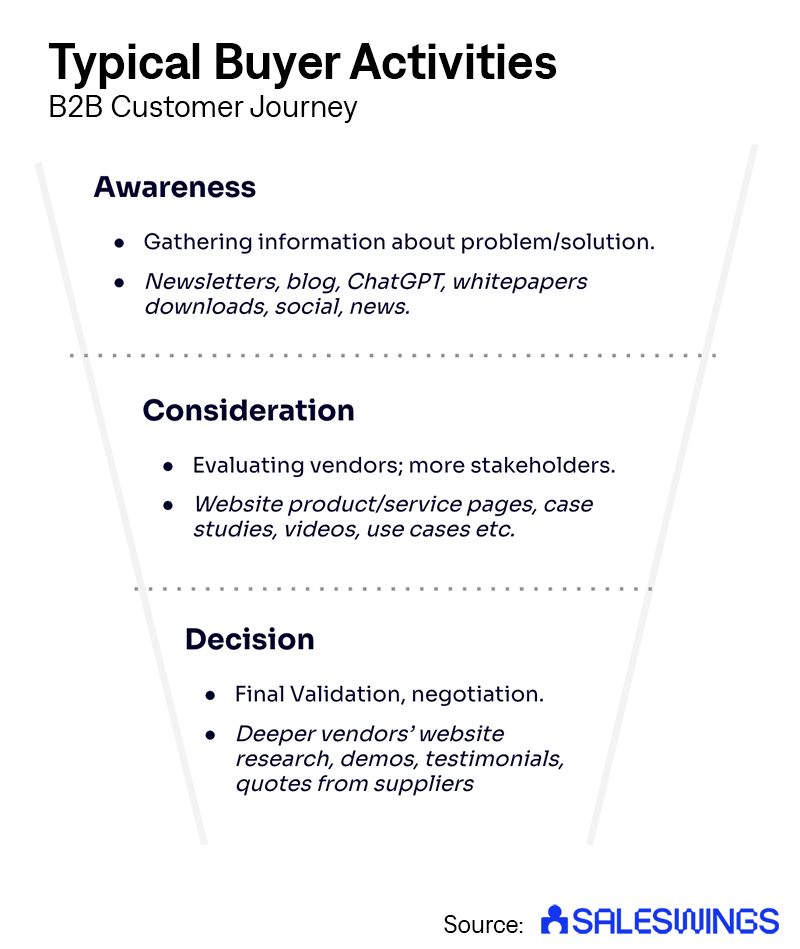
The B2B buyer journey has several stages where different people get involved at different times. Unlike consumer purchases where one person decides, business buying involves committees with representatives from multiple departments, so identifying each stakeholder’s needs is critical to shortlisting you as a vendor.
Common stages include awareness (realizing a problem exists), consideration (researching solutions), evaluation (comparing vendors), purchase (negotiating and signing), onboarding (getting started), and advocacy (recommending to others). Buyers jump between these stages constantly rather than moving through them in order.
Website Engagement
Website activity is the richest source of first-party buyer intent: which pages someone visits, what videos they watch, how long they stay, which PDFs they download. Resource downloads like case studies or ROI calculators often signal serious buying readiness, while browsing patterns help identify interest in a specific product, topic, or even persona (job seeker versus investor versus real prospect).
Behavioral scoring assigns points to different actions to translate behavior into sales-readiness: a pricing page visit might earn more points than a blog read, and repeat visits to demo pages could trigger outreach. Semler Automotive more than doubled email CTR to 25% by acting on exactly this kind of behavioral signal. For the mechanics of actually capturing this activity, see our guide on lead activity and website tracking.
If this is the problem you are working through, Lead Scoring Best Practices covers the next level of detail.
Partner and ABM Channels
Account-based marketing focuses on specific target companies rather than individual leads. ABM touchpoints include personalized emails, targeted LinkedIn ads, and custom landing pages built for specific accounts. Aggregating journey data at the account level lets you segment accounts by offering and campaign, driving higher click-through rates and better ad spend ROI.
Partner channels track interactions through resellers, integrators, or referral partners: leads passed from channel partners, co-branded content engagement, joint event attendance. Partner-driven touchpoints often carry extra weight since they arrive with built-in trust.
Sales and Success Interactions
Sales interactions start with demo requests and discovery calls. Tracking includes who attends meetings, what questions come up, and which stakeholders participate. Proposal views and contract negotiations generate important signals about deal progress.
Customer success touchpoints begin at onboarding and continue through the relationship: training attendance, support ticket volume, feature adoption. Post-purchase engagement often predicts renewal likelihood and expansion opportunity.
Want to see these signals mapped automatically? SalesWings turns website, email, and content engagement into a live view of every buyer’s journey, right inside Salesforce.
Book a callData Sources to Build a Unified Journey View
Effective journey mapping combines information from multiple sources. The goal is one complete record of each customer’s experience, not scattered data across systems.
First-Party Intent Signals
First-party data comes from your owned channels. Real-time website tracking stitches behavior to leads, contacts, and accounts, showing which pages people visit and how they navigate your site. Email platforms like Marketing Cloud or Braze track opens, clicks, and replies, feeding into connected journey tools. Marketing automation records form submissions and content downloads, natively or via a third party.
These signals reveal buyer interest and urgency at multiple levels: someone downloading several case studies and returning to your pricing page repeatedly shows stronger intent than someone who only reads blog posts. Tracking these patterns helps prioritize follow-up and feeds lead and account prioritization.
CRM and Opportunity Data
Salesforce stores information about deals and account relationships: opportunity stages, deal sizes, expected close dates, rep notes. AI copilots can interpret this data and assist sales teams with insights drawn directly from it.
Salesforce data also gives context to marketing activity. When a lead becomes an opportunity after attending a webinar, that webinar gets credit for pipeline influence, connecting marketing activity to sales outcomes and driving better budget decisions.
Qualitative Customer Feedback
Numbers tell you what happened; feedback explains why. Surveys reveal satisfaction and improvement areas. Sales call recordings capture objections and buying criteria. Support tickets highlight common points of confusion.
Win/loss interviews with closed deals are especially valuable: understanding why customers chose you, or chose a competitor, refines messaging and positioning for future prospects. Marketing attribution software can correlate this feedback with business outcomes.
Technology Stack Essentials
Modern journey mapping requires connecting multiple tools. Salesforce often serves as the central hub where customer data comes together, with other platforms feeding into it.
Journey Analytics
Specialized journey analytics tools create visual maps of customer paths, pulling data from websites, email, and advertising platforms into one timeline showing every interaction from first visit through renewal. The goal of tools in this category is understanding the broader journey, not just an individual’s or account’s specific activity, which is where a Salesforce-native approach has an edge: the journey data lives alongside the deal data your sales team already works in, instead of in a separate reporting layer.
If this is the problem you are working through, B2B to B2C Martech Stack Consolidation covers the next level of detail.
Lead Scoring in Salesforce
Some marketing automation tools include basic built-in lead scoring tied into Salesforce, but Salesforce’s own native scoring functionality tends to be inflexible, hard to set up, and costly to maintain. B2C-oriented platforms connected to Salesforce, such as Marketing Cloud, Braze, Iterable, or Insider, aren’t built for B2B either, so they lack solid lead scoring and don’t always tie cleanly into Sales Cloud.
The concept itself is simple: as prospects accumulate points through activity, their scores rise, and sales prioritizes outreach to high-scoring leads who’ve shown stronger buying intent. To improve usability, total cost of ownership, and scoring precision, a Salesforce-native AppExchange partner is usually the better path, offsetting Salesforce’s native limitations while avoiding lock-in to a single vendor’s roadmap.

Real-Time Buyer Intent Alerts
Automated alerts notify teams when prospects take high-value actions. A demo request, repeat pricing page visit, or competitive comparison download can trigger immediate sales follow-up.
These notifications help teams respond while interest is fresh, reaching out within hours instead of waiting for a weekly lead report. Alerts can arrive by email, Slack, or in-browser, depending on how your team works.
Steps to Implement Journey Mapping Across Teams
Implementing journey mapping requires coordination across marketing, sales ops, and customer success. It works best broken into phases.
1. Audit Existing Data
Start by cataloging what customer data already exists. Check data quality in your CRM (it will never be perfect, so don’t let that stop you), review whether your marketing automation is purpose-built and well connected to lead scoring, and identify gaps where important touchpoints aren’t captured.
Common sources include lead website tracking data, engagement from email and omni-channel platforms, ad networks, sales call logs, and support ticket systems. Tools like webinar platforms can connect via Zapier or natively from Sales Cloud. The audit reveals which systems need better integration and where manual processes can be automated.
2. Map Personas and Buying Roles
Document the people involved in purchasing your offering. B2B buying typically involves users (who benefit from it), influencers (who research options), and decision-makers (who approve budget).
Understanding these roles determines which touchpoints matter most for each. A head of sales might look at service offerings, an IT director researches security features, and a CFO focuses on ROI calculations.
3. Define Stage Criteria
Establish clear rules for when prospects move between stages. What actions move someone from awareness to consideration? When does an opportunity become sales-qualified, and how does that map to a lead scoring model?
Clear criteria prevent confusion between teams once you’re using scores for handoff and defining MQL versus SQL. Without a scoring model, marketing and sales can still agree that “requesting a demo” moves someone to evaluation, while “attending a demo” advances them to a mid-funnel nurture track.
4. Configure Dashboards and Alerts
Set up reporting that displays journey data usefully. Good tools surface distilled insights into Sales Cloud without blowing up your storage; for more granular reporting on individual activity, teams typically turn to BI tools like Power BI or Tableau. Dashboards might show the most engaged accounts, which content drives the most pipeline, or where prospects typically stall.
Alerts notify reps about important actions, pricing page visits or competitive downloads can trigger immediate outreach. Send them on the channel that’s least invasive and fits how your reps already work.
5. Launch and Iterate
Start with a pilot, ideally with a team that’s open to trying something new if you have multiple business units. Monitor how data gets collected and how accessible it is across systems, then refine reporting.
Journey mapping improves over time as teams learn which signals actually predict deals and which touchpoints matter less. Regular reviews keep the approach grounded in real results rather than assumptions.
Revenue Metrics That Validate Journey Impact
Pipeline Velocity
Pipeline velocity measures how quickly deals move through stages, calculated from opportunity count, average deal size, win rate, and cycle length. Journey mapping often improves it by removing friction: better qualification means reps spend time on higher-quality prospects, and smoother handoffs accelerate progression.
Revenue Attribution
Revenue attribution connects specific touchpoints to closed deals. Multi-touch models work best for B2B since they credit multiple interactions across the journey rather than just the final meeting; first- and last-touch models fit self-service environments better. Good attribution reveals which activities actually contribute to revenue, a webinar might generate lots of leads, but if few become customers, that budget is better spent elsewhere.
Opportunity-to-Close Rate
This tracks what percentage of opportunities become paying customers. Journey mapping can reveal where prospects typically drop out and why deals stall. Improving this rate usually comes down to better qualification earlier, so sales spends less time on prospects who were never going to buy.
Trends Shaping Journey Mapping and AI
Cookieless Measurement
Browsers are phasing out third-party cookies that many tracking tools relied on. That data (think ad-platform or generic analytics tracking) was often siloed from CRM anyway, so companies are shifting focus to first-party data collected directly through websites, emails, and owned channels, tied straight to your customer records.
Predictive Lead Scoring
Machine learning can analyze behavior patterns to predict future actions, but it needs a lot of historical data and can be overkill for more traditional industries with smaller datasets. It tends to be most useful where volume is high enough to train on, which is why it shows up more in B2C contexts than in most B2B motions.
Privacy-First Personalization
Personalization now leans on consent and transparency: customized experiences built from behavioral data collected with clear permission, not hidden tracking. This builds trust while staying relevant. Prospects who willingly share their challenges and goals get more targeted content and outreach in return.
Journey Data Feeding AI Agents
Giving commercial AI agents access to journey, lead, and account behavior lets them engage prospects at the right moment with the right message. Sales copilots can recommend the ideal talk track for a rep, AI SDRs can personalize outreach to a prospect’s actual interests, and marketing agents can use behavioral insight for sharper segmentation, all from the same underlying journey data.
Common Pitfalls and How to Avoid Them
- Data silos: disconnected tools and data points. Make sure any solution integrates cleanly into your CRM and then into your BI layer.
- Vanity metrics: journey mapping lets you report on almost anything. Stay disciplined about tracking what’s actually actionable.
- One-time mapping: journeys and touchpoints need regular audits, so new data sources and destinations get added as your stack evolves.
Ready to turn your journey map into pipeline? See how SalesWings identifies which accounts are showing real purchase intent, so your team knows exactly where to focus.
Book a callFAQs About B2B Buyer Journey Mapping
How do first-party buyer intent signals improve B2B lead qualification accuracy?
First-party intent data shows specific actions prospects take, watching videos, engaging with ads, downloading pricing guides, attending demos. Marketing ops teams use these behavioral signals to identify seriously interested prospects instead of relying only on demographic information like job title or company size.
What Salesforce integration capabilities matter most for journey mapping tools?
Native Salesforce integration lets customer data insights flow directly into Salesforce without manual uploads or workarounds. Real-time synchronization keeps records current, so sales and marketing always see the latest prospect activity and engagement history.
How often should marketing ops teams update B2B journey maps?
Most teams review journey maps quarterly, and update them sooner when the tech stack changes significantly, new products launch, major campaigns run, or internal feedback surfaces a gap.
Author Bio

Philip Schweizer, SalesWings CEO and Head of Product. Philip is a co-founder at SalesWings, a martech platform that helps revenue teams optimize every step of the funnel through buyer insights, lead scoring, account scoring, and sales intelligence. His experience spans designing and building marketing and sales technology stacks and operational processes, helping marketing and sales operations teams gain efficiency and outcomes at the core of their day-to-day revenue operations.
Want your journey map to actually drive pipeline? Talk to SalesWings about connecting first-party buyer intent straight into Salesforce.
Book a call