

Search Engine Marketing Intelligence: How Revenue Teams Turn Search Data Into Pipeline Insight
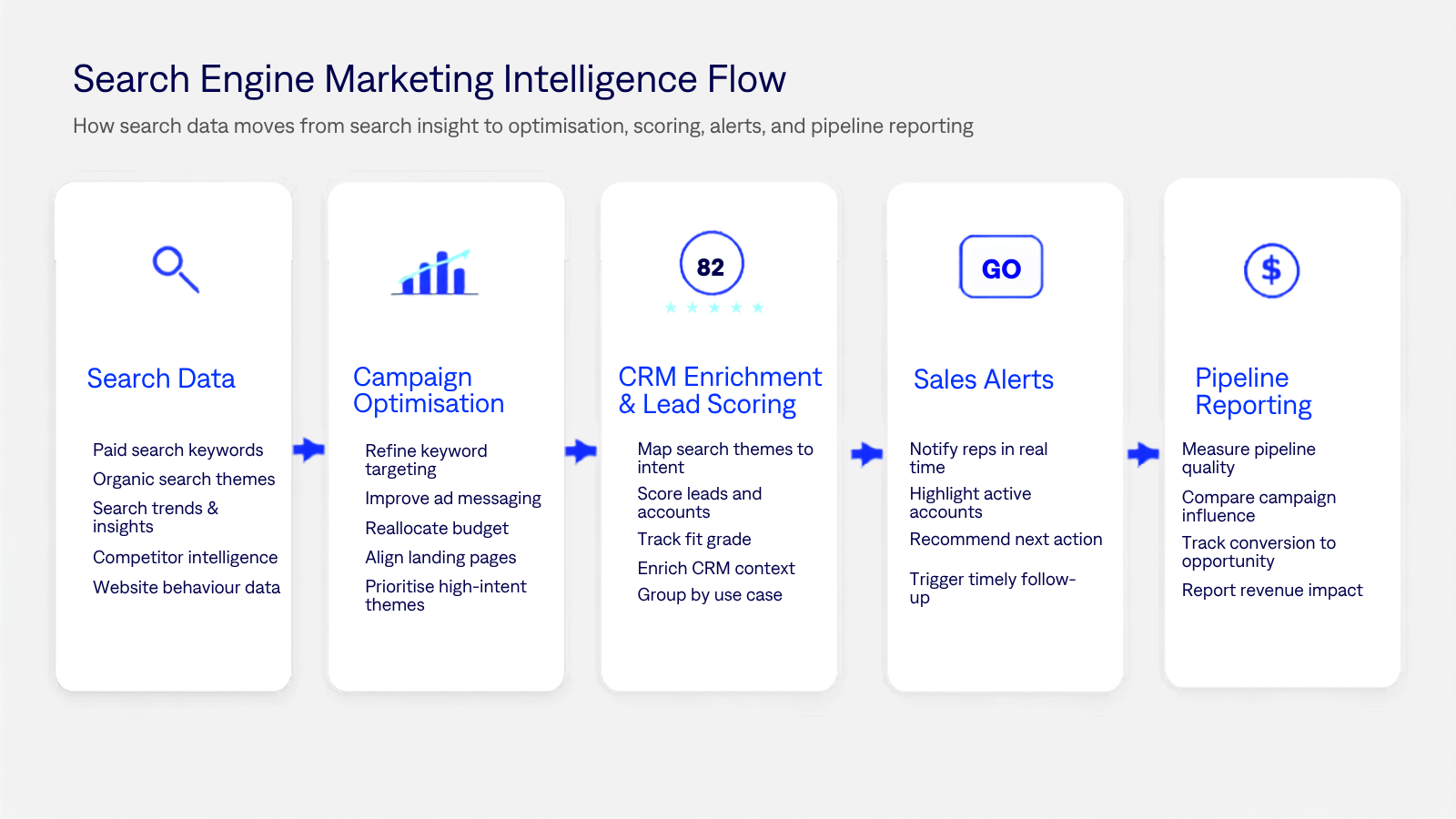
Search engine marketing intelligence is the process of turning search data from paid campaigns, organic visibility, search trends, competitor activity, and first-party engagement into better revenue decisions.
For teams operationalising this, Salesforce Marketing Attribution connects the signals to the next action.
For B2B teams, it helps identify what buyers care about, which accounts are showing intent, which campaigns create qualified demand, and where sales should focus next.
The related guide on Cross Selling goes deeper on this specific issue.
At a campaign level, search engine marketing intelligence improves keyword strategy, targeting, budget allocation, and content planning. At a revenue level, it becomes more valuable when search signals are connected to CRM data, lead scoring, account scoring, attribution, and sales workflows.
1Why search engine marketing intelligence matters beyond campaign reporting
Search data is one of the clearest signals of active demand. Buyers reveal pain points, urgency, product interest, competitive comparisons, and budget-stage intent through the language they use in search.
Google’s own search terms reporting helps advertisers understand how ads performed when triggered by actual user searches, while Google Ads Insights can help teams understand changing search interest for relevant products and services.
But campaign reporting is only the first layer. Revenue teams need to know what happens after the click.
Did the account return to the website? Did they view pricing, product, integration, or case study pages? Did the lead match the ICP? Did the opportunity progress?
That is where search engine marketing intelligence becomes a RevOps discipline rather than a PPC task.
What is search engine marketing intelligence?
Search engine marketing intelligence is the structured analysis of search demand, paid search performance, organic visibility, competitor search activity, and post-click buyer behaviour.
In practical terms, it answers questions such as:
The output should not be another dashboard that only marketing reviews. The output should be decisions: budget shifts, content briefs, scoring rules, sales alerts, audience segments, and campaign experiments.
What data sources should SEM intelligence include?
Strong SEM intelligence combines multiple sources rather than relying on one platform view.
Core data sources include:
The value comes from joining these datasets. A keyword with a high conversion rate may still be weak if it produces poor-fit accounts. A low-volume query may be extremely valuable if it repeatedly appears before enterprise opportunities.
How is SEM intelligence different from SEO or PPC reporting?
SEO reporting usually focuses on rankings, impressions, clicks, content performance, and organic traffic. PPC reporting usually focuses on spend, click-through rate, cost per click, conversion rate, cost per lead, and return on ad spend.
Search engine marketing intelligence is broader. It connects search visibility to buyer intent, account behaviour, pipeline creation, and sales action.
Table: SEO reporting vs PPC reporting vs SEM intelligence
| Reporting layer | Focus |
|---|---|
| SEO reporting: | Focuses on organic visibility, rankings, content performance, and technical search health. |
| PPC reporting: | Focuses on paid traffic, budget efficiency, campaign conversion, and keyword-level performance. |
| Search engine marketing intelligence: | Focuses on buyer demand, search intent, competitive pressure, lead quality, account engagement, and revenue impact. |
| Key takeaway: | Search engine marketing intelligence is not a replacement for SEO or PPC reporting. It is the layer that turns both into revenue intelligence. |
2The search engine marketing intelligence framework for B2B revenue teams
The best SEM intelligence systems follow a simple pattern: capture demand signals, classify them, connect them to buyer behaviour, and measure their revenue impact.
That sounds straightforward, but many teams stop too early. They collect search data but never make it useful for sales, segmentation, or prioritisation.
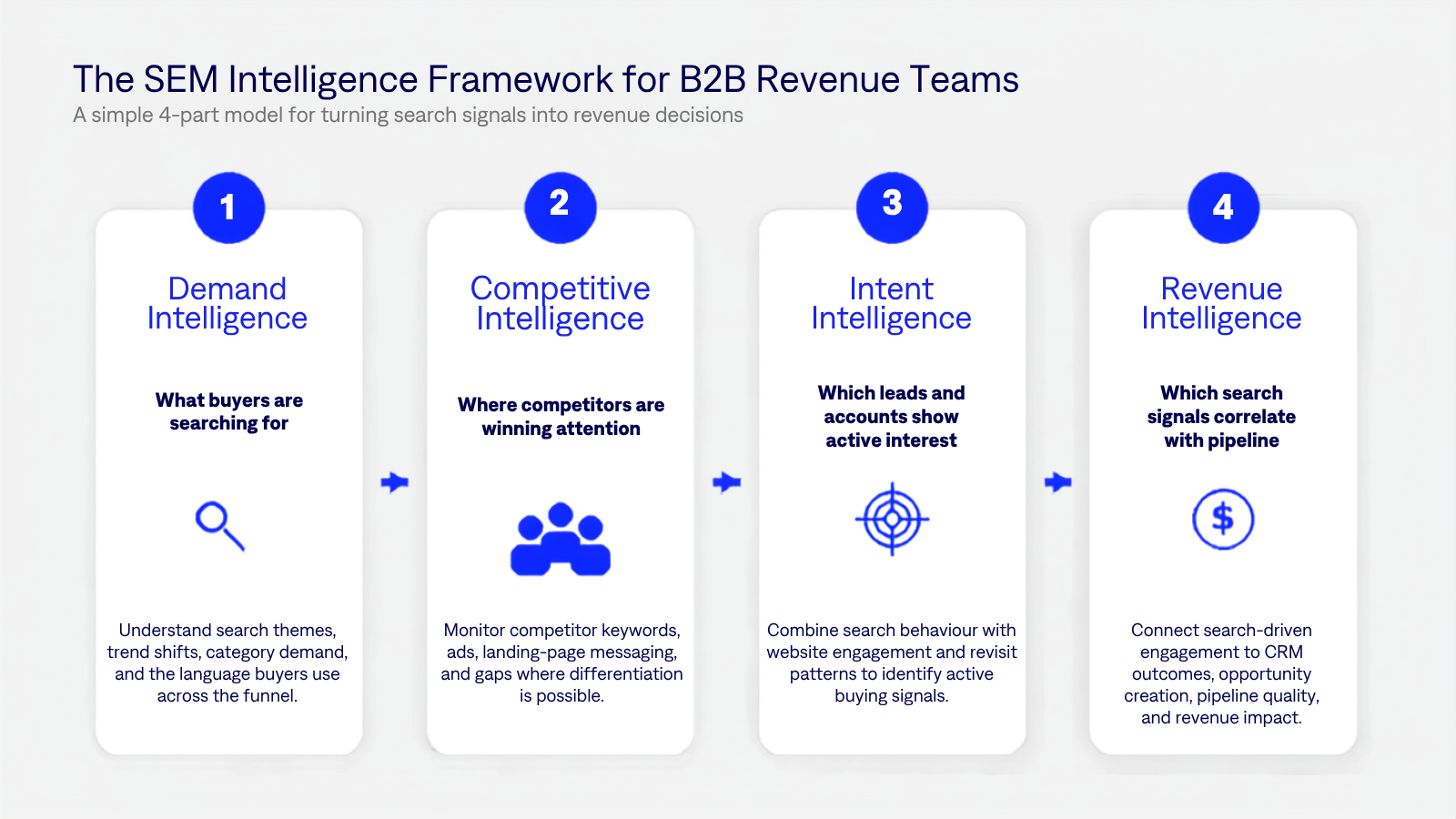
Demand intelligence: what buyers are searching for
Demand intelligence starts with the language of the market.
Look beyond exact keywords and group searches into themes:
For Marketing Ops and Demand Gen teams, this helps prioritise campaign structure, landing pages, nurture content, and sales enablement.
For RevOps teams, it helps define intent categories that can later be mapped to lead and account scores.
Competitive intelligence: where competitors are winning attention
Competitive search intelligence helps teams understand where competitors are visible, what messages they use, and which commercial topics they appear to prioritise.
This matters because competitor visibility can shape buyer perception before your sales team ever enters the conversation.
Useful questions include:
The goal is not to copy competitors. The goal is to identify market pressure, messaging gaps, and opportunities to differentiate.
Intent intelligence: which leads and accounts are showing active interest
Intent intelligence is where search engine marketing intelligence becomes especially useful for B2B revenue teams.
For more detail on this part of the topic, see Top 14 Salesforce ISV Solutions for Marketing Operations Management.
A search click alone is not enough. The real signal is what happens next.
A lead who arrives from a high-intent query, returns twice in a week, views product pages, and engages with follow-up content should not be treated the same as a one-time visitor who downloads a generic checklist.
This is where first-party behavioural tracking matters. SalesWings, for example, helps teams track website activity, email engagement, and digital behaviour at the lead and account level, then surface interest signals in Salesforce.
The related guide on Can I Measure Lead Engagement goes deeper on this specific issue.
For Marketing Ops, this supports better segmentation. For Sales Ops, it supports better prioritisation. For sales teams, it creates more relevant outreach.
Revenue intelligence: which search signals correlate with pipeline quality
The highest-value question is not “which keyword converted?” It is “which search themes create qualified pipeline?”
To answer that, connect search and engagement data to CRM outcomes:
This changes how teams evaluate search performance.
A campaign with a higher CPL may deserve more budget if it produces better-fit accounts and stronger opportunity creation. A campaign with cheap leads may need to be reduced if sales consistently rejects the leads.
Review SEM intelligence monthly for campaign optimisation, but review revenue correlation quarterly. B2B sales cycles can make weekly pipeline conclusions misleading.
3How to operationalise search engine marketing intelligence inside Salesforce
Search intelligence becomes operational when it changes what teams do inside Salesforce.
For most B2B teams, that means turning search and behavioural signals into fields, scores, reports, alerts, and views that sales and marketing can actually use.
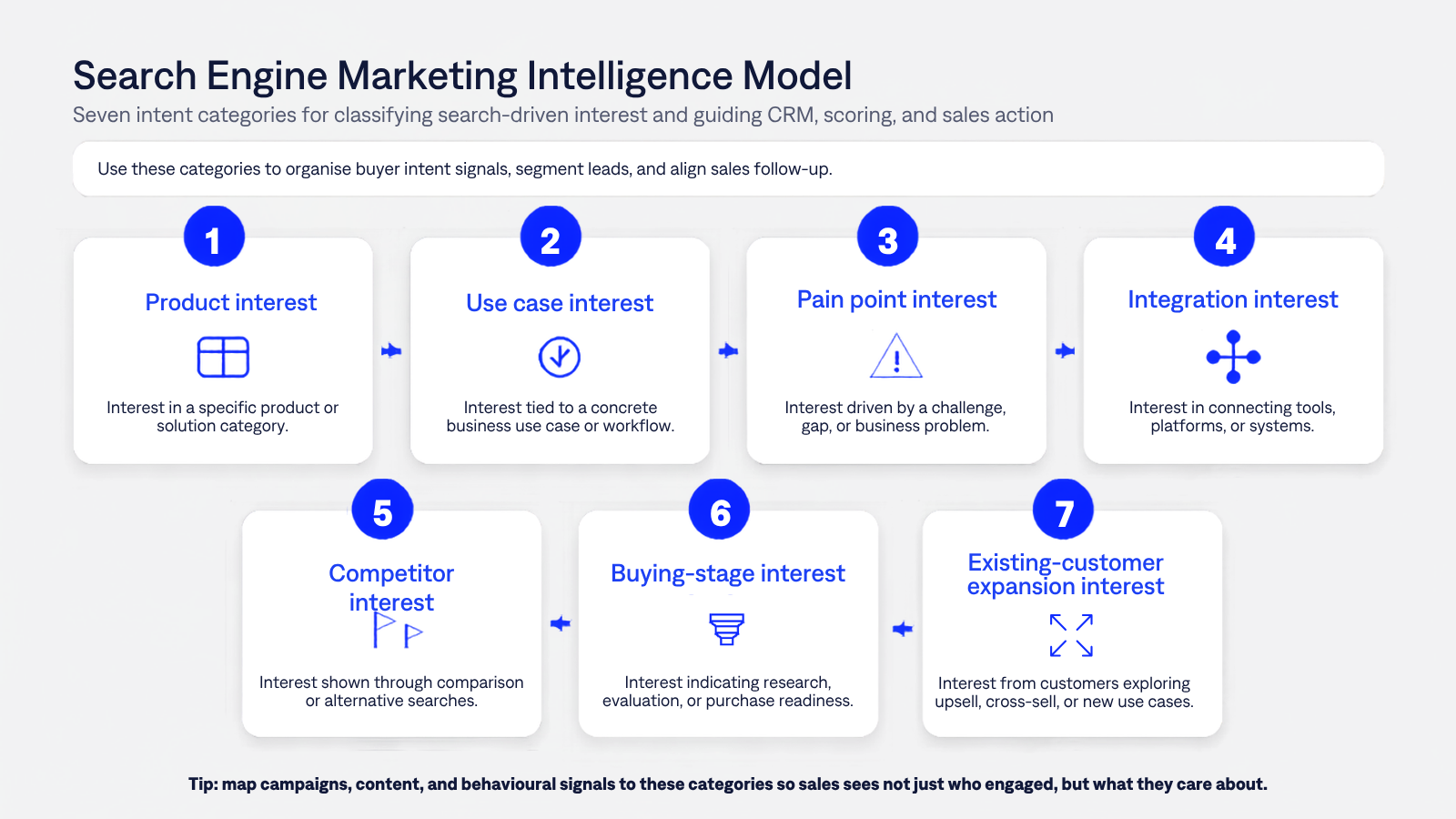
Map search themes to buying intent categories
Start by translating search terms into intent categories.
For example:
A useful starting model:
Connect campaign engagement to lead and account scoring
Once search themes are mapped, they can inform scoring.
This does not mean every paid search click should add the same number of points. A branded search, category search, competitor search, and problem-led search may represent very different intent levels.
A more useful model combines:
SalesWings supports point-based lead and account scoring, fit scoring, and behavioural engagement scoring inside Salesforce.
Table: Example scoring logic for search-driven intent
| Search or behaviour signal | Possible interpretation | Operational action |
|---|---|---|
| High-intent product query followed by pricing page visit | Active solution evaluation | Increase product-interest score and notify sales |
| Problem-led query followed by educational content only | Early-stage research | Add to nurture segment and monitor return visits |
| Competitor comparison query followed by case study visit | Vendor evaluation | Increase buying-stage score and route to relevant SDR |
| Multiple contacts from same account visiting integration pages | Account-level buying committee activity | Increase account score and flag for sales review |
Alert sales when search-driven accounts show high intent
Sales does not need every search detail. Sales needs timely context they can act on.
Useful alerts should answer:
For example, an alert that says “Lead visited website” is weak. An alert that says “Director of Marketing at target account returned to the Salesforce integration page after arriving from a lead scoring campaign” is much more useful.
SalesWings can surface lead and account insights in Salesforce and send real-time alerts through channels such as email, Slack, browser notifications, and its Chrome extension.
The operational goal is simple: help reps focus on the right accounts at the right moment with the right conversation.
4Common mistakes that weaken search engine marketing intelligence
Search engine marketing intelligence often fails because teams build reporting before they define decisions.
Dashboards are useful only when they change budget, messaging, routing, scoring, or sales behaviour.
Mistake 1: treating search terms as campaign data only
Search terms are not only PPC optimisation inputs. They are market research.
They show how buyers describe problems, alternatives, use cases, competitors, and urgency.
Marketing teams should use search term analysis to improve:
Objection handling
Google’s search terms report is designed to show how ads performed when triggered by actual searches, but B2B teams can extract strategic insight beyond bid and keyword changes.
Mistake 2: optimising for cost per lead without lead quality context
Cost per lead is easy to measure and easy to misuse.
A low CPL campaign can look efficient while quietly creating SDR waste. A higher CPL campaign can look expensive while generating better-fit accounts and stronger sales conversations.
This is especially common in B2B SaaS, where form fills do not always equal buying intent.
Better SEM intelligence should track:
The goal is not to ignore efficiency. The goal is to define efficiency through pipeline quality, not lead volume alone.
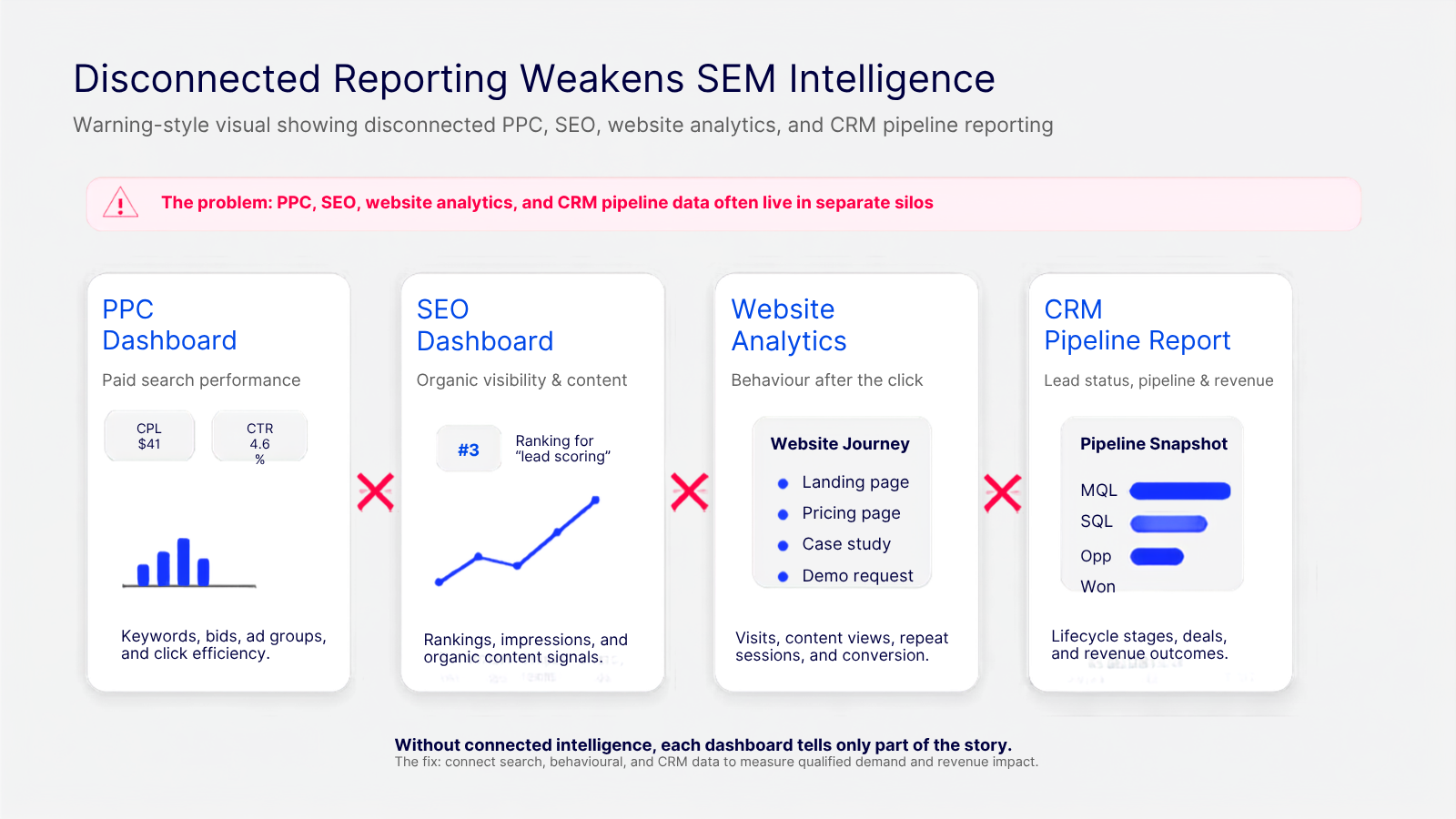
Mistake 3: separating paid search, organic search, and CRM reporting
Paid search, SEO, and CRM reporting often sit in different systems with different owners.
That creates three partial truths:
Search engine marketing intelligence requires these views to come together.
For RevOps, this means standardising campaign taxonomy, UTM governance, lifecycle stages, attribution fields, and reporting logic. For Marketing Ops, it means aligning search themes with segmentation, scoring, and nurture operations.
The biggest SEM intelligence gains often come less from buying another keyword tool and more from connecting existing search, behavioural, and CRM data properly.
5Examples of search engine marketing intelligence in practice
The following examples are practical operating scenarios, not customer case studies. No SEM-specific SalesWings customer case study was used here because the verified customer stories focus primarily on behavioural tracking, lead scoring, segmentation, and Salesforce visibility rather than search engine marketing intelligence specifically.
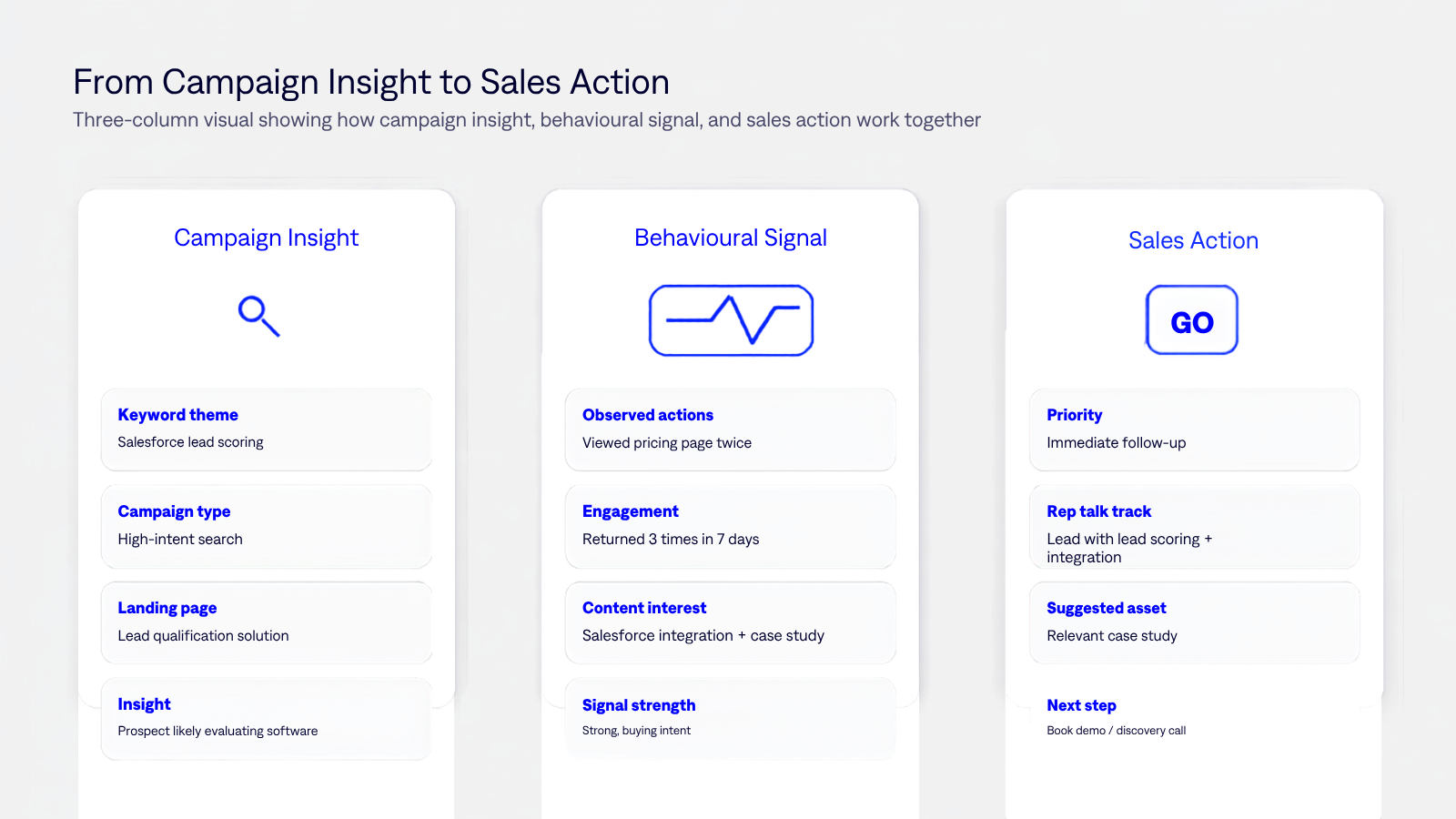
Example 1: prioritising high-intent demo requests
A SaaS company runs paid search campaigns across category, competitor, and problem-led keywords.
Historically, every demo request is routed the same way. Sales responds based on form submission time, not buying intent.
With SEM intelligence, the team maps search themes to intent categories. Demo requests from high-intent category and integration searches receive higher engagement scores when paired with strong website behaviour.
The sales team now sees not only the demo request, but also the likely area of interest.
Operational impact:
Example 2: identifying product interest by search theme
A company sells multiple products to overlapping buyer personas.
Paid search reports show conversions, but the sales team often lacks context. A lead may be interested in reporting, lead scoring, website personalisation, or sales alerts.
By classifying search themes into product-interest categories, Marketing Ops can segment leads more accurately.
For example:
Example 3: improving sales conversations with search-informed context
Search intelligence should not overload sales with raw keyword data.
Instead, it should translate behaviour into usable context.
A sales rep does not need a long list of search terms. They need to know that the account has shown repeated interest in lead scoring, Salesforce integration, and sales alerts over the past 14 days.
That context can shape the talk track:
This is how search engine marketing intelligence becomes sales intelligence.
6Build a search intelligence loop that improves every quarter
Search engine marketing intelligence is most valuable when it becomes a repeatable operating loop.
A strong quarterly loop looks like this:
The teams that get this right do not just optimise campaigns. They build a clearer view of market demand and buyer readiness.
Search engine marketing intelligence helps B2B teams understand what buyers are looking for, where competitors are visible, which leads are showing intent, and which campaigns create pipeline. When combined with first-party behavioural data and Salesforce visibility, it becomes a practical system for better prioritisation, segmentation, and revenue execution.
For revenue teams, the next step is not another isolated report. It is a better intelligence loop.
Further reading
Digitising Sales and Marketing Processes in the Real Estate Industry
See SalesWings in action
Book a short call to see how SalesWings turns first-party intent data into Salesforce lead scoring, account scoring, campaign reporting, and sales-ready insights.
