

Cross Selling: How B2B Revenue Teams Identify and Convert Expansion Opportunities
Cross selling is the practice of offering an existing customer an additional product, service, module, or solution that complements what they already use.
In B2B SaaS, effective cross selling is not about pushing more products into an account; it is about identifying where a customer has a relevant business need, clear fit, and timely buying intent.
For revenue teams, cross selling can become one of the most efficient growth levers because the relationship already exists. The challenge is operational: knowing which customers are ready, what they are likely to need next, and when sales or customer success should act.
1What cross selling means in a B2B revenue strategy
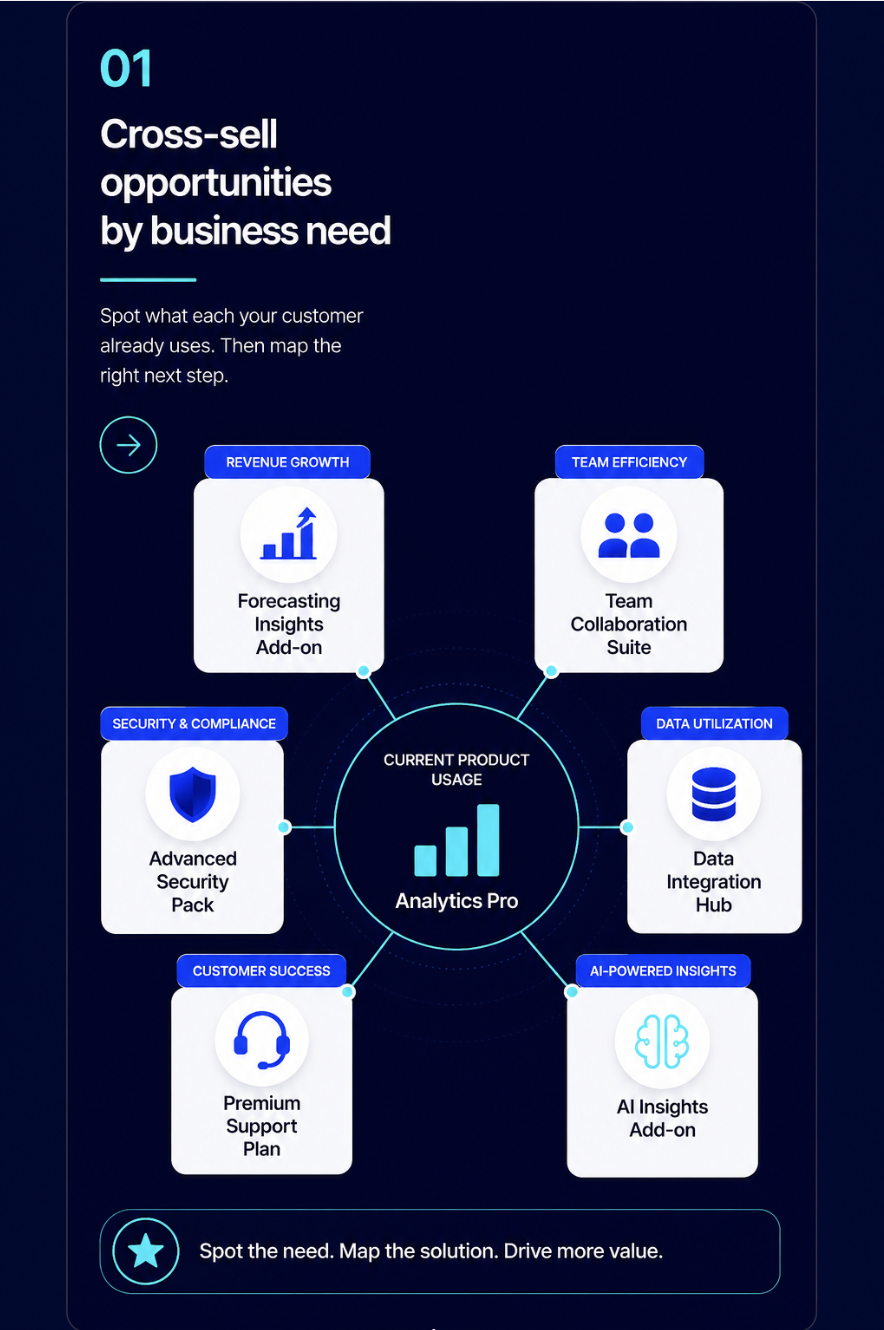
Cross selling turns existing customer relationships into relevant expansion conversations. Instead of acquiring a new logo, the revenue team helps an existing account solve an adjacent problem with another product, package, integration, service, or use case.
In B2B SaaS, this might mean selling:
- An additional product module to a current customer.
- A premium reporting or analytics package.
- A security, compliance, or governance add-on.
- A service package connected to implementation or enablement.
- A second business unit or regional team within the same account.
What is cross selling?
Cross selling means recommending a complementary solution to an existing customer based on their current relationship, needs, behaviour, or account profile. A strong cross-sell motion starts with relevance: the additional offer should make sense in the context of the customer’s goals, maturity, and engagement.
For example, a company using a core CRM integration might later need attribution reporting, account scoring, or behavioural segmentation once their demand generation motion becomes more sophisticated.
What is the difference between cross selling and upselling?
Cross selling and upselling both support expansion revenue, but they are not the same motion.
Cross selling introduces an additional product or service. Upselling moves the customer to a higher tier, larger package, or expanded version of what they already use.
Table: Cross selling vs upselling in B2B SaaS
| Motion | What it does | Example | Best trigger |
|---|---|---|---|
| Cross selling | Adds a complementary product, module, or service. | A customer using lead scoring adds marketing attribution. | New use case, adjacent need, product interest, stakeholder expansion. |
| Upselling | Expands the existing product commitment. | A customer moves from a standard plan to an enterprise plan. | Usage growth, seat expansion, limits reached, maturity increase. |
Both motions require timing and trust. The difference is that cross selling asks, “What else does this account need?” while upselling asks, “Are they ready for more of what they already have?”
Why does cross selling matter for SaaS revenue teams?
Cross selling matters because many B2B teams are under pressure to grow more efficiently. Acquiring new customers is important, but expansion revenue often depends on how well teams understand and activate the customers they already have.
For Marketing Ops and RevOps leaders, cross selling also creates a useful test of data quality. If the team cannot identify which accounts own which products, which accounts match the right profile, and which accounts are showing intent, expansion campaigns will remain broad and inconsistent.
McKinsey’s analysis of experience-led growth connects customer experience improvements with metrics such as wallet share, cross-sell, and net revenue retention.
2Cross selling works when timing, fit, and intent align
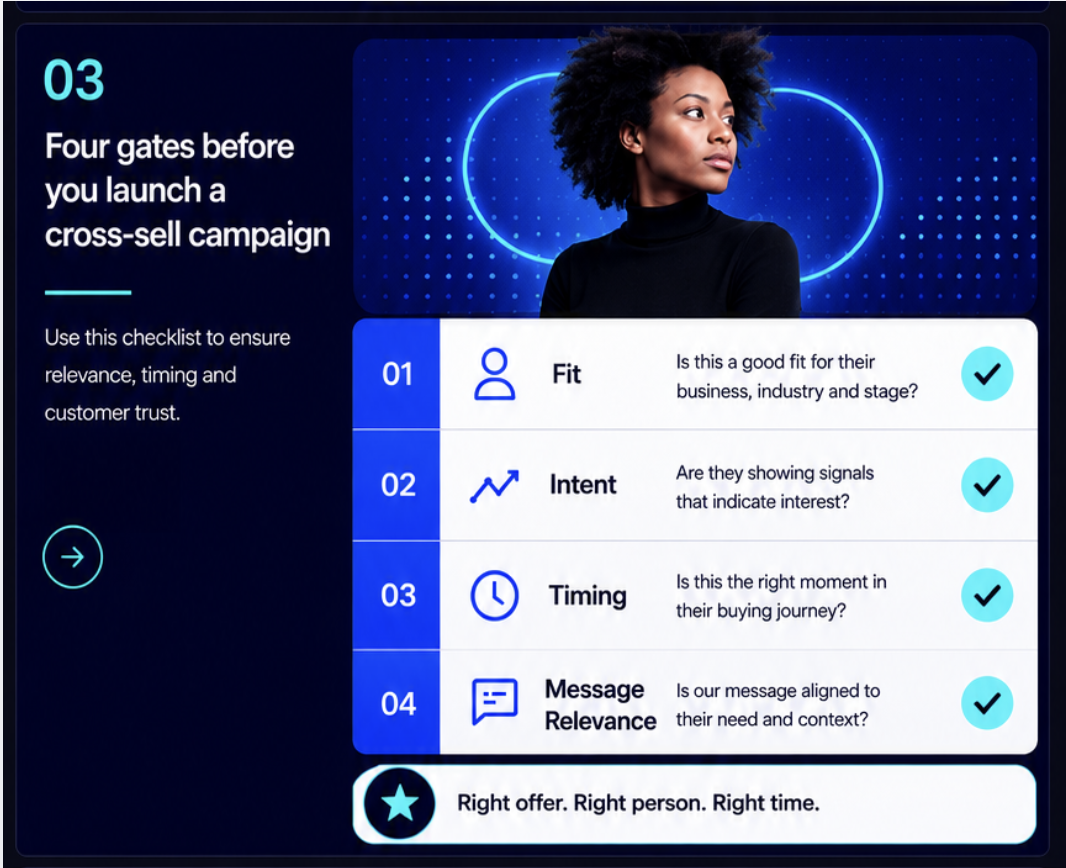
The best cross selling opportunities usually appear where three signals overlap: fit, intent, and timing.
If the account fits but shows no interest, the offer may feel premature. If the account shows interest but does not fit the product, sales may waste time. If fit and intent are both present but the timing is wrong, the conversation may stall.
Fit: the account has a real use case for the additional product
Fit answers the question: should this account realistically buy this additional solution?
For B2B SaaS teams, fit can include:
- Industry.
- Company size.
- Region.
- Revenue band.
- Current product ownership.
- Technology stack.
- Team structure.
- Customer maturity.
- Existing contract value.
- Strategic account status.
This is where lead grading and fit scoring become useful. A customer may engage heavily with content about an advanced product, but if the product is designed for enterprise teams and the customer is a small business, the cross-sell motion may not be worth immediate sales attention.
Intent: the account is showing interest in a relevant topic
Intent answers the question: is the account showing behaviour that suggests interest in the additional product or problem area?
In a first-party data context, useful cross selling signals can include:
- Visits to product, pricing, comparison, or integration pages.
- Engagement with emails about a specific use case.
- Webinar attendance related to an adjacent product.
- Content downloads around a problem the additional product solves.
- Repeat visits from multiple stakeholders in the same account.
- Salesloft, Outreach, or email engagement connected to a campaign theme.
For example, if several contacts at a customer account repeatedly engage with content about account scoring, that can indicate a stronger cross-sell opportunity than a single page view from one user.
SalesWings supports this type of motion by helping revenue teams identify first-party behavioural intent at the lead and account level, then surface that insight inside Salesforce for sales and marketing teams.
Teams can use behavioural segmentation and intent identification to understand which products, topics, or services an account is actively researching.
Timing: the customer is ready for a commercial conversation
Timing answers the question: should anyone act now?
A customer can be a strong fit and show interest, but still not be ready for a sales conversation. Timing often depends on operational context.
Useful timing signals include:
- Renewal or business review approaching.
- Recent product adoption milestone.
- Expansion into a new department or region.
- New executive stakeholder joining the account.
- Increase in product usage or team size.
- Repeat engagement over a short period.
- Active campaign response from multiple contacts.
Strong cross selling processes avoid one-off reactions. They look for patterns that suggest the account is moving from passive interest to active evaluation.
Gartner’s guidance on the B2B buying journey reinforces why sales and marketing teams need to understand where digital and human interactions should support the buying process.
See SalesWings in action
Book a short call to see how SalesWings turns first-party intent data into Salesforce lead scoring, account scoring, campaign reporting, and sales-ready insights.
3How to build a cross selling process RevOps can actually manage
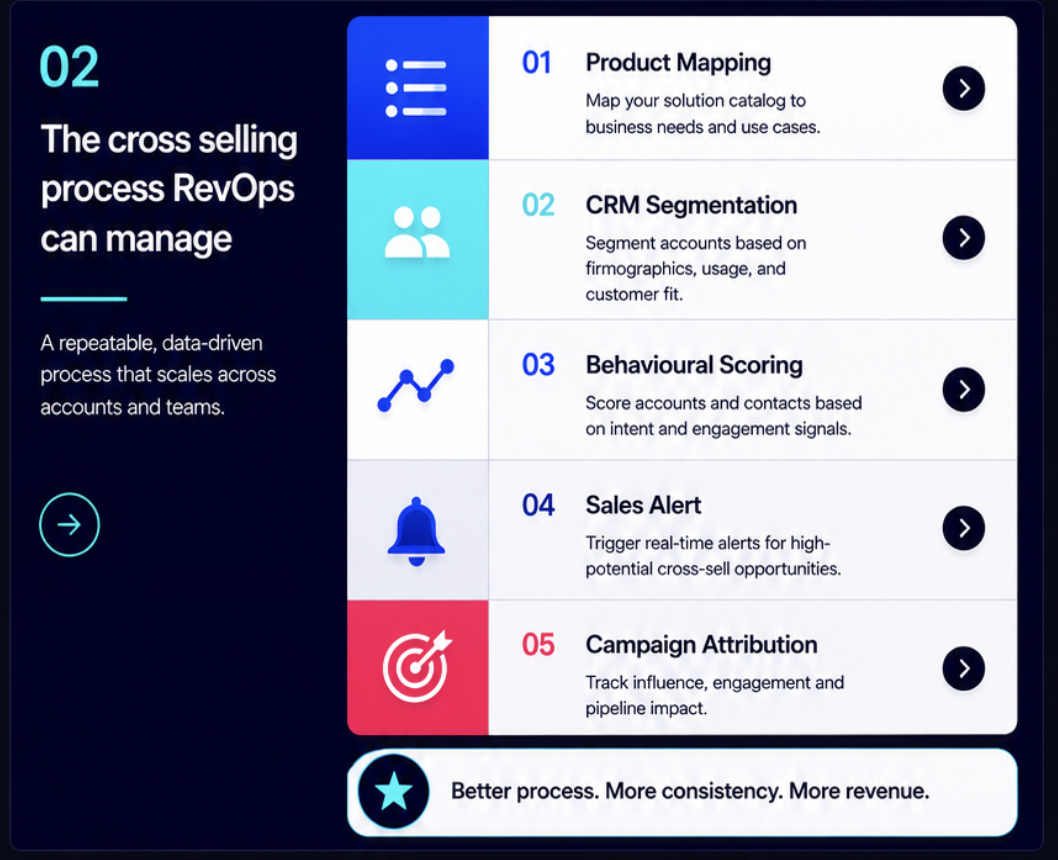
Cross selling fails when it depends on individual reps remembering which accounts might need which products. It becomes scalable when RevOps turns it into a repeatable operating model.
The goal is not to automate every conversation. The goal is to make the right opportunities visible at the right time.
Step 1: Map products to customer problems
Start by mapping each product or add-on to the customer problem it solves. This keeps cross selling focused on relevance rather than product promotion.
A simple mapping model:
Advanced attribution reporting
Marketing needs to prove campaign influence on pipeline and opportunity wins.
Marketing Ops, Demand Generation, RevOps, CMO.
Readiness signals: Repeated engagement with attribution content, campaign reporting pages, Salesforce reporting resources, or budget planning content.
Sales motion: Marketing-led education followed by RevOps or sales consultation.
This exercise should be completed before campaigns are built. Without it, teams often create generic “you may also like” campaigns that feel more like ecommerce recommendations than B2B expansion strategy.
Step 2: Build cross-sell segments in your CRM
Cross selling requires clean segmentation. At minimum, your CRM should help teams identify:
- Customers who own Product A but not Product B.
- Customers in industries where Product B performs well.
- Customers with the right company size or maturity.
- Customers with active contacts in relevant roles.
- Customers with recent engagement around Product B topics.
- Customers approaching renewal or business review dates.
This is where Marketing Ops and RevOps need shared definitions. A campaign audience should not be built only from product ownership data. It should also include fit and engagement criteria.
For Salesforce-led teams, a Salesforce integration for lead prioritisation can help revenue teams connect behavioural signals to the CRM records sales already uses.
Step 3: Use behavioural signals to prioritise accounts
Once segments exist, behavioural signals help teams prioritise within them.
A practical cross-sell scoring model might combine:
- Fit score: Does the account match the ideal profile for the additional product?
- Engagement score: Is the account actively engaging with relevant content, campaigns, or digital channels?
- Product interest: Which product, topic, service, or business unit is the account showing interest in?
- Stakeholder depth: Is engagement coming from one contact or several people across the buying group?
- Sales readiness: Is the activity recent, repeated, and connected to high-intent pages or assets?
SalesWings can support this kind of prioritisation through lead and account scoring, separate scoring categories, and first-party behavioural signals connected to Salesforce records.
Step 4: Route the right signal to the right team
Not every cross selling signal should go to sales immediately.
Some signals belong with marketing. Some belong with customer success. Some deserve direct sales follow-up.
Table: Who should act on different cross-sell signals?
| Signal | Best owner | Recommended action |
|---|---|---|
| A customer clicks one email about an adjacent product. | Marketing | Add to a nurture stream or educational campaign. |
| Multiple contacts visit product and pricing pages in the same week. | Sales or account manager | Trigger a personalised follow-up. |
| A customer engages with implementation or integration content. | Customer success or solutions consultant | Discuss operational fit in the next account conversation. |
| A strategic account shows repeated engagement before renewal. | Account manager and CSM | Include the topic in the business review. |
| A low-fit account clicks several product pages. | Marketing Ops | Monitor, but avoid immediate sales routing unless fit changes. |
The routing model should also reflect your sales and marketing alignment process, so teams know which signals require nurture, CSM review, or direct sales action.
4Common cross selling mistakes that reduce trust
Cross selling can improve customer value, but poorly executed cross selling can damage trust. The difference usually comes down to relevance and timing.
Customers can tell when a message is based on their needs. They can also tell when it is based only on a revenue target.
Mistake 1: Treating every customer as an expansion opportunity
Not every customer is ready to expand. Some are still adopting the first product. Some are not a good fit for the additional offer. Some may be at risk and need support before any commercial conversation.
A strong cross selling process excludes accounts as carefully as it includes them.
Before launching a campaign, define:
- Which customers should be included.
- Which customers should be suppressed.
- Which accounts need CSM review first.
- Which accounts should stay in education rather than sales follow-up.
Mistake 2: Using product interest without account fit
Behavioural intent is useful, but it should not be used in isolation. A contact may engage with content for research, curiosity, or internal education.
That is why cross-sell prioritisation should combine engagement with profile and account data.
A better model is:
Sales-ready cross-sell opportunity.
Nurture and educate.
Review before routing.
Suppress or deprioritise.
Mistake 3: Sending generic campaigns instead of context-aware messages
Generic cross-sell campaigns often fail because they talk about the product instead of the customer’s problem.
A stronger message connects three things:
- What the customer already uses.
- What signal or need suggests a next step.
- What business outcome the additional solution supports.
For example, instead of saying, “You may be interested in our attribution module,” a stronger message would say, “Teams using lead scoring often reach a point where they also need to show which campaigns influence qualified pipeline. Here is a practical framework for connecting engagement data to campaign reporting.”
Harvard Business Review’s article on personalisation done right highlights why companies need a clear standard for relevant, appropriate personalisation.
See SalesWings in action
Book a short call to see how SalesWings turns first-party intent data into Salesforce lead scoring, account scoring, campaign reporting, and sales-ready insights.
5Cross selling examples for B2B SaaS teams
The strongest cross selling examples are specific. They connect a customer’s existing product, observed behaviour, and likely next problem.
Below are three practical examples B2B SaaS revenue teams can adapt.
Example 1: Cross selling a reporting module to high-engagement users
A customer already uses lead scoring to prioritise inbound demand. Over several weeks, multiple marketing stakeholders from the account engage with content about campaign reporting, attribution, and revenue influence.
A strong cross-sell motion would not immediately push a demo. Instead, marketing could send a practical guide on measuring campaign influence, while the account manager receives an alert that the account is showing interest in reporting topics.
The next conversation can then focus on the customer’s reporting challenge rather than the product itself.
Example 2: Cross selling an enterprise package to a growing account
A mid-market customer expands into new regions and adds more users. Their usage increases, and several stakeholders begin reviewing governance, permissions, and integration documentation.
This may indicate readiness for an enterprise-level package or additional administrative features. The account manager can frame the conversation around operational scalability, not simply a higher plan.
Example 3: Cross selling services based on topic-level intent
A customer repeatedly engages with content about Salesforce reporting, sales handoff, and account prioritisation. They may not need a new product first; they may need advisory support or implementation services to improve their process.
This is an important point for RevOps teams: not every cross selling opportunity is product-led. Sometimes the most relevant offer is enablement, consulting, onboarding, or technical configuration.
6How to measure cross selling performance
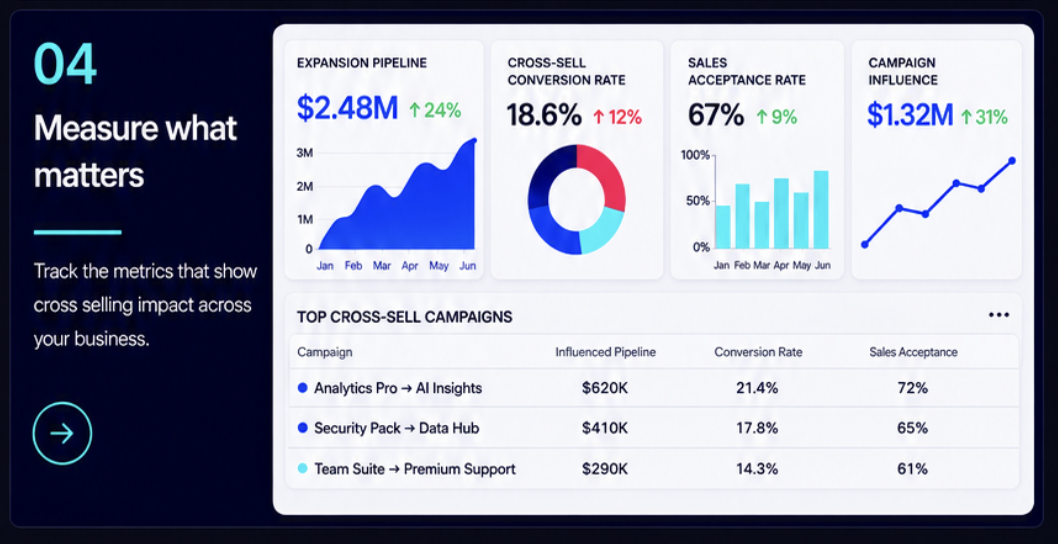
Cross selling should be measured as a revenue process, not just a campaign tactic. Marketing, sales, RevOps, and customer success should share a small set of metrics that show whether the motion is creating qualified expansion demand.
Expansion pipeline created
Expansion pipeline created shows how much qualified pipeline comes from cross-sell opportunities.
Useful views include:
- Pipeline by product.
- Pipeline by customer segment.
- Pipeline by original signal source.
- Pipeline by campaign.
- Pipeline by account owner or region.
This helps teams identify which cross-sell motions are commercially meaningful and which are creating activity without revenue impact.
Cross-sell conversion rate
Cross-sell conversion rate measures how many targeted accounts move from signal to opportunity, and from opportunity to closed-won expansion.
A simple funnel might track:
- Accounts in the eligible segment.
- Accounts showing relevant intent.
- Accounts accepted by sales or CSM.
- Opportunities created.
- Opportunities won.
- Expansion revenue generated.
The key is to measure conversion by segment, not only in aggregate. A 5% conversion rate may be strong for one segment and weak for another.
Campaign influence and sales acceptance
Marketing should also measure whether cross-sell campaigns influence the right opportunities.
Useful questions include:
- Which campaigns generated meaningful engagement from existing customers?
- Which topics led to sales-accepted expansion opportunities?
- Which behavioural signals appeared before opportunity creation?
- Which campaigns influenced opportunity close rates?
- Which segments should be removed from future campaigns?
For teams measuring expansion motion inside Salesforce, marketing attribution and campaign reporting can help connect customer engagement with opportunity outcomes.
Ready to make expansion opportunities easier to measure?
See how SalesWings connects behavioural engagement, lead and account scoring, and Salesforce reporting so RevOps can track which signals turn into real cross-sell pipeline.
7Cross selling becomes predictable when revenue teams use the right signals
Cross selling works best when it is treated as a disciplined revenue process, not a one-off sales tactic. The most effective teams combine account fit, behavioural intent, product ownership, and timing to decide which customers are ready for which expansion conversation.
For B2B SaaS teams, the opportunity is clear: existing customers often leave signals before they raise their hand. They visit product pages, engage with educational content, attend webinars, involve new stakeholders, and show interest in adjacent problems.
The revenue teams that capture those signals can turn cross selling into a more relevant, timely, and measurable motion.
SalesWings helps teams connect first-party behavioural data, lead and account scoring, and Salesforce-native sales insights so cross-sell opportunities become easier to identify and act on. But the broader principle applies to any revenue team: better signals create better expansion conversations.
Revenue teams that improve cross selling do not just sell more to existing customers. They build a clearer understanding of what customers need next.
See SalesWings in action
Book a short call to see how SalesWings turns first-party intent data into Salesforce lead scoring, account scoring, campaign reporting, and sales-ready insights.
