

A SaaS company can have an established B2C marketing operation, thousands of customers and a sophisticated CRM setup, and yet still struggle when it begins selling to businesses.
The problem is that B2B and B2C buying journeys are fundamentally different.
A consumer might research a product, sign up and make a purchase in one session. A business buyer may return several times, compare solutions, involve colleagues and engage with marketing long before they’re ready to speak to sales.
For SaaS companies expanding into B2B, that creates an operational challenge.
How do you qualify business demand, understand what prospects are interested in and give sales the information it needs, without rebuilding your entire marketing technology stack?
This was the challenge facing Logos, a Bible study technology company serving millions of users worldwide.

As its B2B division grew, Logos needed to turn an established qualification framework into a working sales process. Its existing Salesforce environment had been built primarily around B2C operations, and implementing the new process was proving difficult.
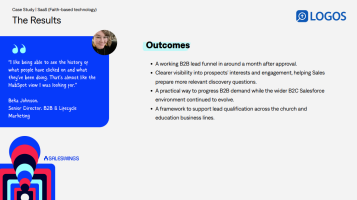
Working with SalesWings, Logos established a functioning B2B lead funnel in around a month after approval, bringing together qualification rules, lead progression and visibility into buyer engagement.
Read the full Logos case study: Bringing buyer intent data into Salesforce in 35 days
The experience highlights a broader challenge for SaaS companies developing B2B revenue streams: connecting existing marketing infrastructure to a fundamentally different buying process.
Why B2C marketing infrastructure doesn’t always work for B2B
Many SaaS companies expand into B2B using the same marketing and CRM infrastructure that supported their original consumer business.
Initially, this makes sense. The company already has websites, customer records, email campaigns, marketing automation and established reporting processes.
But the requirements change as the B2B business grows.
A consumer marketing operation may focus heavily on signups, subscriptions, purchases and individual customer engagement. A B2B revenue team needs to understand a different set of questions:
- Which businesses are showing significant interest?
- Who are the relevant contacts within those organizations?
- What products or services are they researching?
- How engaged is each prospect, beyond a single form submission?
- Which contacts should sales prioritize, and which need further nurturing?
- When should a lead progress to the next stage of the funnel?
These questions require more than a database of contacts and their original acquisition sources. They require a structured way to understand demand and turn it into a sales process.
The gap between generating B2B leads and actually qualifying them
Consider a SaaS business that launches a new offering for enterprise customers. Marketing starts generating enquiries through paid campaigns, organic search, webinars and website forms. The early numbers look encouraging.
But as lead volume grows, the limitations of the existing process become apparent.
Marketing can report how many leads have arrived. It might also know which campaigns generated them. What it cannot necessarily see is which prospects are becoming more engaged, what they’re researching or whether they’re approaching a buying decision.
Without that context, leads may enter a generic nurture sequence or be passed to sales before sufficient interest has developed. As lead volume increases, manual qualification becomes increasingly difficult.
The missing step is turning engagement into a clear understanding of each prospect’s interests, fit and readiness for sales.
Demographic and firmographic data can help establish whether someone matches the ideal customer profile. Behavioral data can reveal how that prospect is interacting with the business. Together, they provide a stronger basis for qualification than either source alone.
Build a B2B qualification framework around the buying journey
Before selecting technology or configuring a scoring model, companies need to establish what a qualified B2B prospect looks like. The framework should reflect how customers evaluate and purchase the product.
- Customer fit. Does the prospect match the target industry, company profile, role or market segment?
- Areas of interest. Which products, solutions or business challenges appear to be relevant?
- Level of engagement. Is someone conducting early research or repeatedly engaging with relevant content?
- Lead progression. What needs to happen before a prospect moves from marketing nurture to sales qualification?
- Sales context. What information would help a sales representative prepare for a useful conversation?
Different B2B product lines may need different qualification criteria. A SaaS company selling to educational institutions and commercial businesses might have distinct audiences, buying cycles and qualification requirements.
The objective is to build a consistent framework while retaining the flexibility to reflect how each business line operates.
Why Salesforce implementation can become a bottleneck
Having Salesforce and a marketing automation platform doesn’t necessarily mean a company has an operational B2B lead management process.
A CRM can store records, manage opportunities and support workflows, but teams still need to configure the rules that determine how prospects are qualified, routed and progressed.
That can become more complicated when the Salesforce environment was originally designed for a different business model.
A company may have established consumer lifecycle campaigns, customer data structures and operational processes that cannot simply be replaced to accommodate a growing B2B division.
The B2B marketing team may know exactly what it wants to achieve, yet struggle to put those requirements into production. The business wants to increase B2B revenue now, but the broader systems roadmap may take months.
The long-term project: Evolve the wider CRM and marketing infrastructure to meet the requirements of the business.
The immediate requirement: Give marketing and sales a practical way to understand, qualify and progress B2B demand.
Those projects do not always need to be completed at the same time.
Make buyer behavior visible to sales
Lead qualification is only one part of an effective B2B funnel. Sales also needs to understand why a prospect is worth contacting.
Consider two leads with similar company profiles who have both submitted an enquiry. One visited the website once and downloaded a general resource. The other has returned several times, researched a specific product, engaged with relevant campaign content and recently revisited a solution page.
Those are different levels of engagement, even though both leads entered the CRM through a form.
Behavioral intelligence helps reveal those differences. It gives sales a clearer understanding of:
- Which products and services a prospect has researched.
- How their interests have developed over time.
- Which marketing content they have engaged with.
- Whether recent activity suggests renewed or increasing interest.
- What topics might be relevant during a discovery conversation.
Importantly, this information should be available within the sales workflow. Requiring sales representatives to open separate analytics systems and reconstruct a prospect’s journey creates unnecessary work.
Instead, engagement history and areas of interest can be brought into Salesforce alongside existing contact and opportunity information.
A SaaS case study: How Logos built its B2B sales funnel in 35 days
Read the full Logos case study
Logos is a U.S.-based technology company known for its Bible study platform, supporting individuals as well as church and education customers.
As its B2B division expanded, Logos needed a more structured way to manage demand. The company had built its Salesforce and Salesforce Marketing Cloud environment around a primarily B2C business.
The inbound marketing team already had a framework for customer qualification, including relevant touchpoints and ideal customer profiles. What it lacked was an operational process for applying that framework.
Beka Johnson, Senior Director, B2B & Lifecycle Marketing at Logos, described the starting point:
“I had no lead stages, no lead scores yet. I could tell you we had this many leads, and someone filled out a form, but that’s all I had.”
Moving forward without rebuilding Salesforce
The team initially explored using its existing Salesforce tools to support the planned B2B process. After approximately two months, it still lacked a workable implementation.
Meanwhile, new leads continued entering the funnel. Some received basic manually created stages, while others entered generic nurture.
Following approval, SalesWings worked with the Logos operations and marketing teams to translate the existing qualification framework into a working process. The implementation covered lead stages, routing, and demographic and behavioral qualification rules.
Within around a month of approval, Logos had a working B2B lead funnel.
The team could qualify and progress demand across its church business, with a framework to support the education business as it developed.
Giving sales a clearer understanding of buyer interests
SalesWings gave Logos greater visibility into what prospects had engaged with and how their interests developed.
Rather than relying entirely on form submissions or lead stages, sales representatives could review engagement history before starting a conversation.
As Johnson explained:
“I like being able to see the history of what people have clicked on and what they’ve been doing. That’s almost like the HubSpot view I was looking for.”
That additional context helped sales prepare more relevant discovery questions and gave the B2B team a foundation for progressing demand while the wider Salesforce environment continued to evolve.
Read the full Logos case study: Bringing buyer intent data into Salesforce in 35 days
Use the same behavioral data across marketing and sales
The benefits of a shared view of engagement extend across the revenue organization.
Marketing needs to understand which prospects are moving closer to a sales conversation. Sales needs to know which accounts and contacts deserve attention, and what they’re interested in. Revenue operations needs consistent qualification criteria that can be applied across the business.
First-party behavioral intelligence can support all three.
For marketing, engagement data can inform audience segmentation, nurturing and lead progression. For sales, the same information provides context for outreach and discovery. For RevOps, connecting behavioral engagement to Salesforce creates a more consistent foundation for qualification, routing and reporting.
Rather than treating every buyer journey identically, teams can apply different qualification models while working from a shared understanding of customer and prospect activity.
How to launch a B2B funnel without overcomplicating the process
For companies working through a similar transition, the starting point should be the commercial process rather than the technology.
1. Define the ideal B2B customer
Establish which organizations and stakeholders the business wants to reach. Where multiple products or markets are involved, account for the differences between them.
2. Map the engagement signals that matter
Identify the website activity, campaign interactions and other behaviors that help reveal genuine interest. Not every page visit or email click should carry equal weight.
3. Establish clear qualification and progression criteria
Decide how customer fit and engagement should inform lead stages, prioritization and routing. Keep the initial framework manageable and refine it as the team learns.
4. Make engagement history available in Salesforce
Ensure sales representatives can understand a prospect’s areas and levels of interest without having to interpret data from multiple systems.
5. Improve the process using real opportunities
Review which qualification signals are useful, whether leads are reaching sales at the right time and where prospects are getting stuck. Use those findings to improve the process over time.
A workable initial funnel can be more valuable than an elaborate model that takes months to implement.
B2B growth shouldn’t have to wait for a CRM overhaul
SaaS businesses expanding from B2C to B2B face a challenge that goes beyond generating leads. They need to understand a different type of buying journey, establish appropriate qualification criteria and give sales the context required to develop opportunities.
That doesn’t necessarily mean abandoning existing marketing infrastructure or rebuilding Salesforce from the ground up.
The immediate priority is to make the data already being collected useful to the teams responsible for revenue.
Logos provides an example of how quickly this can happen when the qualification framework is clear and the right tools are available to put it into practice.
Download the Logos case study to see how SalesWings supported the implementation.
