

B2B Lead Scoring Criteria Examples: How to Build a Better Qualification Model
B2B lead scoring criteria examples typically include firmographic fit, job role, company size, industry, website activity, high-intent page visits, form submissions, email engagement, event attendance, account-level activity, and negative signals such as poor-fit industries or inactive leads.
The strongest models do not treat all activity equally. They separate who the buyer is, how well the account matches your ICP, what the buyer is doing, and whether the timing suggests sales readiness.
B2B lead scoring criteria should help answer one practical question: which leads and accounts deserve sales attention now, and why? Understanding the characteristics of your leads is crucial for effective engagement. Utilizing the top tools for lead scoring analysis can provide insights that help prioritize outreach efforts. With accurate scoring, sales teams can focus their strategies on the most promising opportunities, ensuring better conversion rates.
Layer 1
Buyer fit
Layer 2
Account fit
Layer 3
Buying intent
Layer 4
Sales action
TL;DR
B2B lead scoring criteria in 60 seconds
A strong B2B lead scoring model combines fit, firmographics, behaviour, content engagement, account activity, and negative scoring. The goal is not to track more data. The goal is to help marketing and sales teams identify high-fit, high-intent leads faster and trigger the right follow-up inside the CRM.
For more detail on this part of the process, see Search Engine Marketing Intelligence.
For RevOps and Marketing Ops teams, B2B lead scoring is most useful when it improves prioritisation, routing, sales alerts, nurture segmentation, and pipeline reporting. That requires a model that is simple enough for sales to trust, but specific enough to reflect real buying signals.
That means your B2B lead scoring criteria should answer four practical questions:
Is this person a good-fit buyer?
Is this company a good-fit account?
Is there meaningful buying intent?
Is the timing strong enough for sales follow-up?
When those questions are answered clearly, lead scoring becomes more than an MQL mechanism. It becomes an operating system for lead qualification, routing, sales alerts, nurture segmentation, and campaign performance reporting.
1What are good examples of B2B lead scoring criteria?
B2B lead scoring criteria are the attributes and behaviours used to assign value to a lead, contact, or account. These criteria help teams judge whether a person fits the ideal customer profile, whether their company is worth pursuing, and whether recent activity suggests buying intent.
A simple example would be a VP at a target account who visits a pricing page, returns to the website twice in one week, and submits a demo form. That lead should usually be prioritised above a poor-fit contact who only downloaded a top-of-funnel guide.
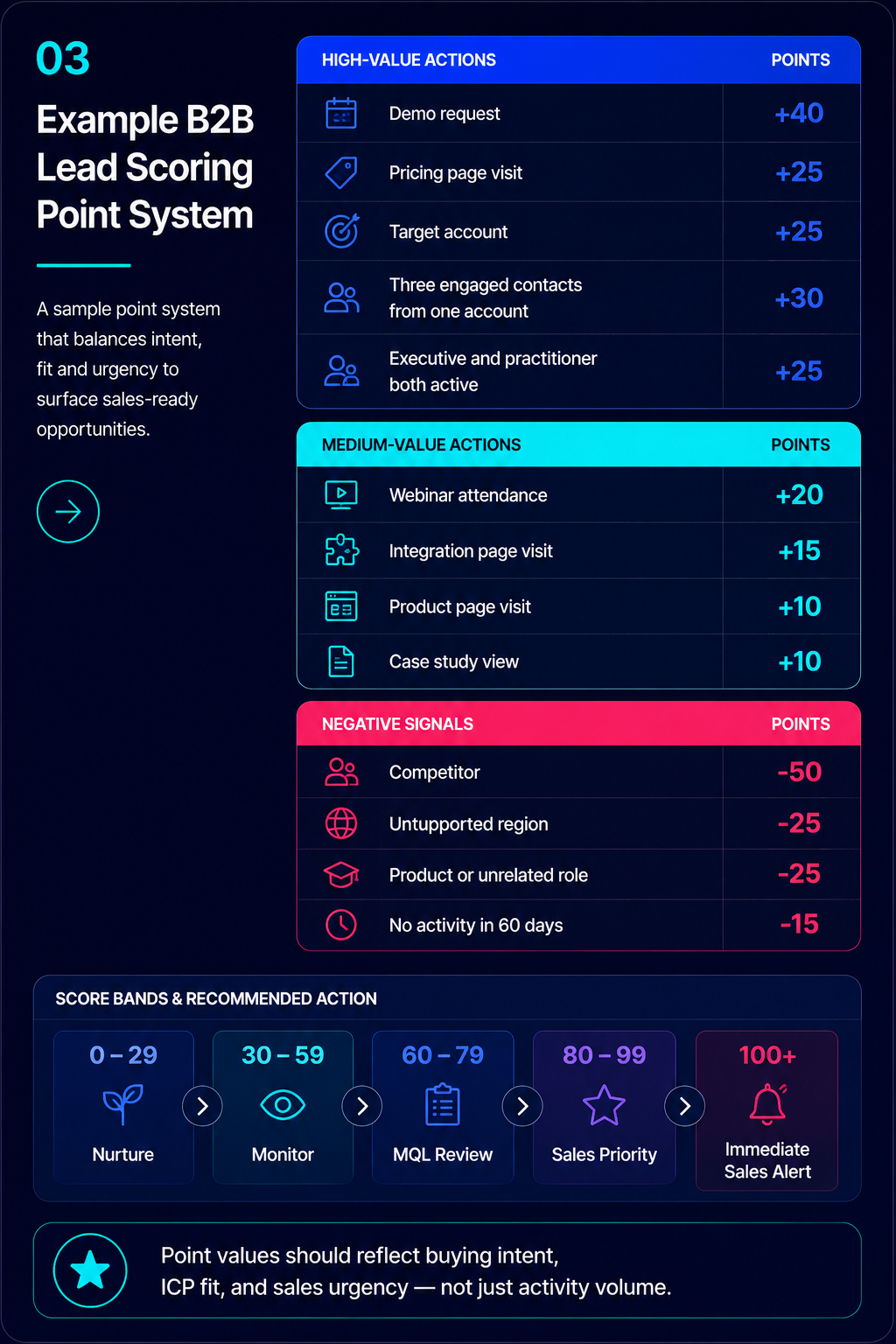
Fit
Who is this buyer?
Job title, department, seniority, persona, and territory.
Account
Is the company valuable?
Industry, company size, revenue, geography, and target account status.
Intent
Are they showing interest?
Pricing views, demo requests, product research, email clicks, and webinar activity.
2B2B lead scoring criteria examples by category
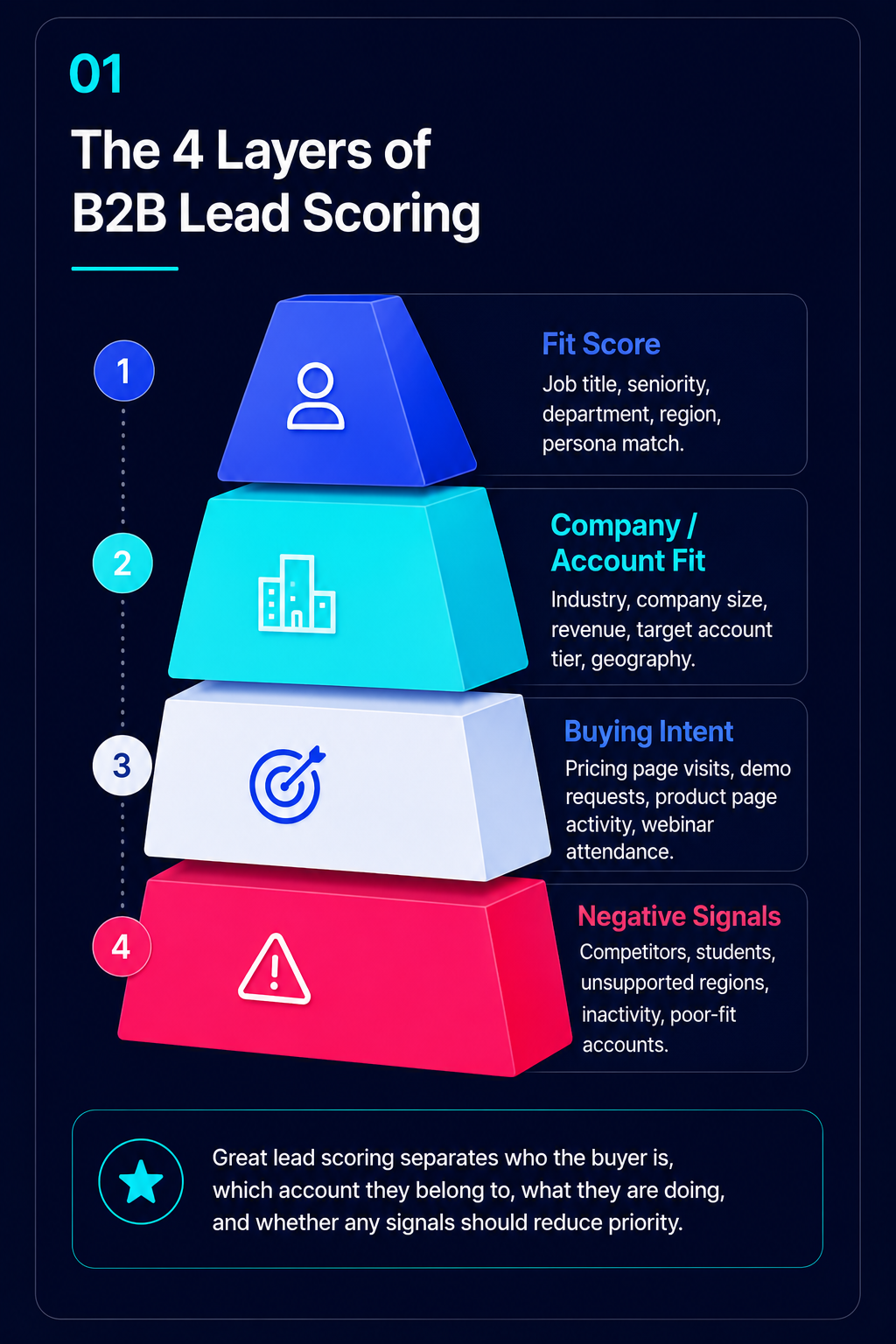
The most useful B2B lead scoring criteria examples fall into six categories: persona fit, firmographic fit, behavioural intent, content engagement, account activity, and negative scoring.
For the practical implementation, see Braze B2B Lead Scoring.
Category 1
Persona fit
Job title, role, seniority, department, region, and buying influence.
Category 2
Firmographic fit
Company size, industry, revenue, geography, and ICP match.
Category 3
Behavioural intent
Pricing pages, product pages, demo requests, comparison pages, and return visits.
Category 4
Content engagement
Webinars, buyer guides, ROI calculators, case studies, and security content.
Category 5
Account activity
Multiple engaged contacts, buying committee activity, and target-account momentum.
Category 6
Negative criteria
Competitors, students, vendors, unsupported regions, inactivity, and poor-fit accounts.
Using these categories together helps prevent a common scoring problem: treating a single action, such as a content download, as if it proves sales readiness. Real buying intent usually appears as a pattern across fit, behaviour, timing, and account context.
3Lead scoring criteria examples with point values
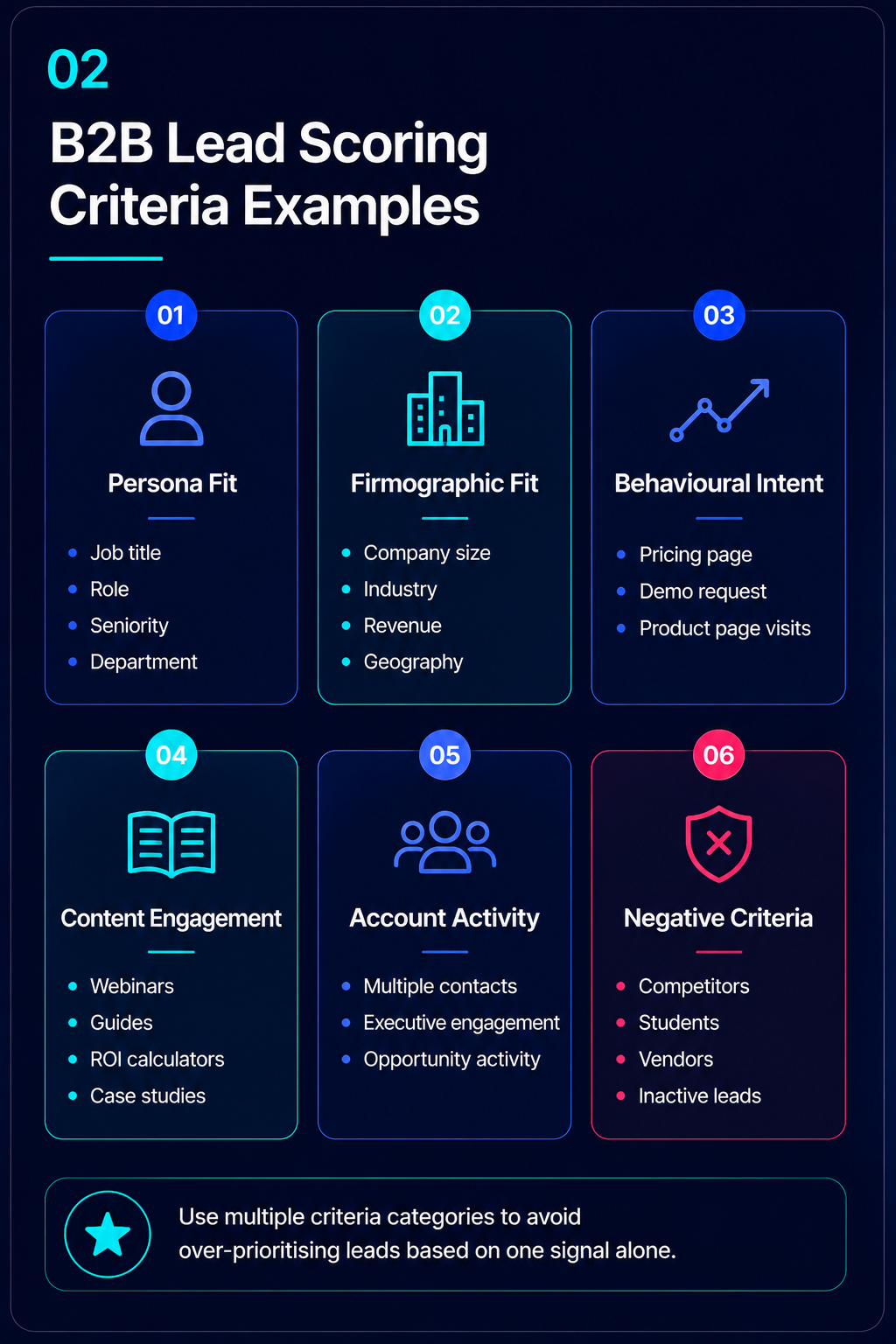
Point values should reflect buying-stage strength, ICP fit, and sales urgency. A demo request deserves more weight than a blog visit. A pricing page visit from a target-account VP deserves more attention than a content download from a poor-fit contact.
| Criteria type | Example signal | Example points |
|---|---|---|
| High-intent behaviour | Demo request | +40 |
| Buying-stage activity | Pricing page visit | +25 |
| Account fit | Target account | +25 |
| Persona fit | Decision-maker or senior influencer | +20 |
| Account activity | Three engaged contacts from one account | +30 |
| Negative fit | Competitor or student | -25 to -50 |
0–29
Nurture
Low priority. Keep educating and monitoring.
30–59
Monitor
Engaged, but not yet clearly sales-ready.
60–79
MQL review
Check fit, intent, and sales routing rules.
80+
Sales priority
Route to SDR or account owner quickly.
4How to choose the right B2B lead scoring criteria (with examples)
The right criteria should come from your actual sales process, not from a generic template. Start by looking at recently converted opportunities, sales-accepted leads, and deals that moved quickly from first engagement to pipeline.
Start with conversion data
What do good opportunities have in common?
Compare won deals, qualified opportunities, and rejected leads to find patterns in persona, company size, source, behaviour, and timing.
Validate with sales
Would a rep act on this signal?
If sales cannot explain why a score matters, the scoring model needs clearer criteria, better weighting, or more visible context.
A useful scoring model should also include negative criteria. Without score reduction rules, stale leads and poor-fit contacts can stay artificially inflated and weaken sales trust.
5Fit scoring vs behavioural scoring examples
Fit scoring and behavioural scoring answer different questions. Fit scoring tells you whether the lead or account is worth pursuing. Behavioural scoring tells you whether there is evidence of current interest.
| Scoring type | What it measures | Example criteria |
|---|---|---|
| Fit scoring | How closely the lead matches your ICP | Job title, seniority, department, region |
| Firmographic scoring | How closely the company matches your target account profile | Company size, industry, revenue, geography |
| Behavioural scoring | How much intent the lead is showing | Pricing views, demo requests, product page visits |
| Account scoring | Whether the wider company is showing buying activity | Multiple contacts, buying committee engagement, open opportunity activity |
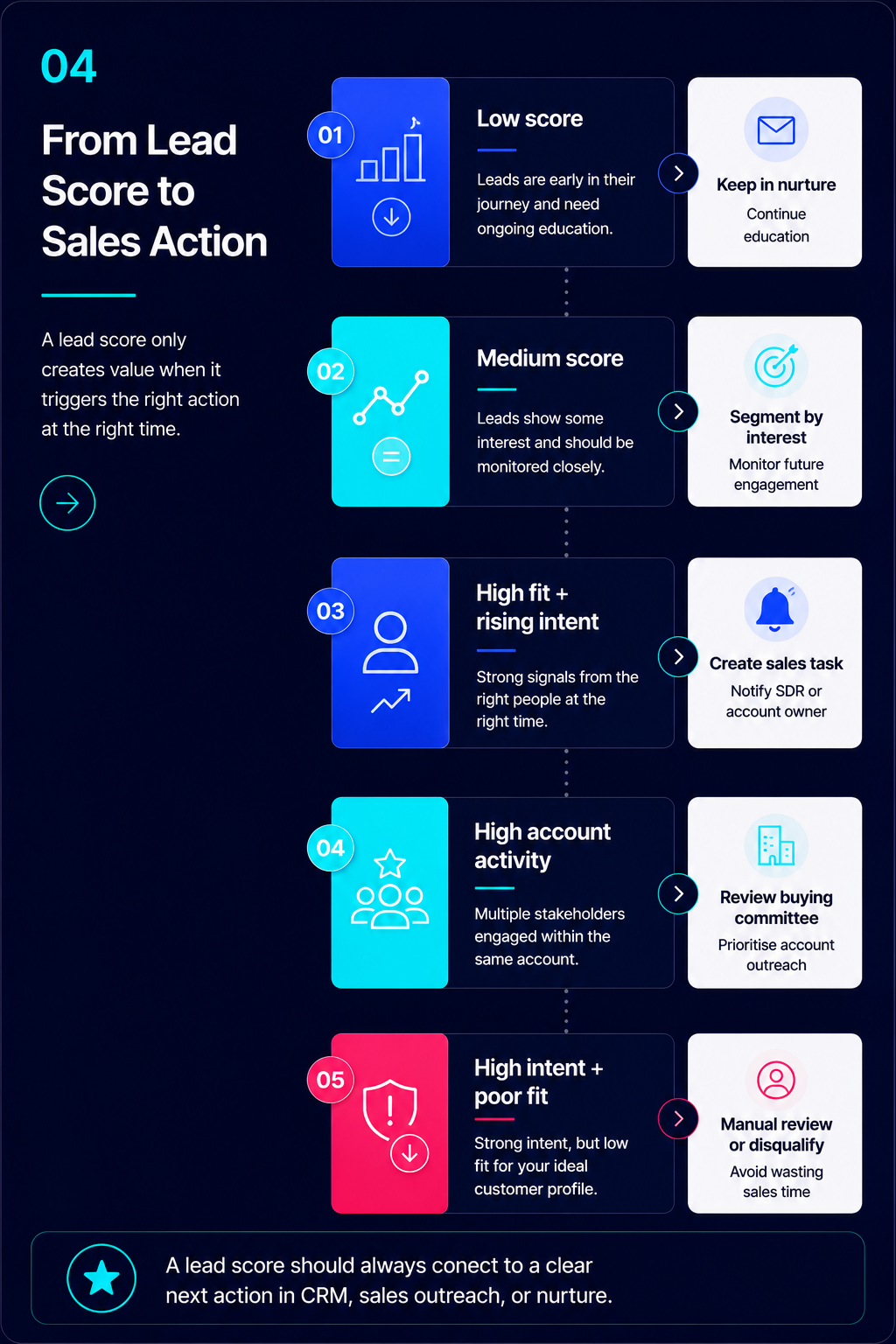
6From lead score to sales action
A lead score is only useful if it changes what happens next. Each score band should connect to a clear action in CRM, nurture, routing, or sales follow-up.
Low score
Keep in nurture
Continue education and monitor for stronger buying signals.
Medium score
Segment by interest
Use topic activity to personalise campaigns and future nurture.
High score
Trigger sales follow-up
Create a task, alert the owner, or route the lead to SDR review.
Sales teams also need to see why the score changed. Instead of only showing a number, provide the recent activity that explains it: pricing page views, product interest, account activity, recent email clicks, and ICP fit.
See SalesWings in action
Book a short call to see how SalesWings turns first-party intent data into Salesforce lead scoring, account scoring, campaign reporting, and sales-ready insights.
7Common mistakes with B2B lead scoring criteria
Lead scoring models often fail because they reward activity without enough context. The result is a score that looks precise but does not help sales focus.
| Mistake | Why it hurts | Better approach |
|---|---|---|
| Treating every form fill as sales-ready | Inflates low-intent content downloads | Weight forms by buying stage |
| Ignoring account activity | Misses buying committee behaviour | Track lead and account scores together |
| Overweighting engagement without fit | Pushes poor-fit leads to sales | Combine behaviour with ICP scoring |
| Forgetting score decay | Makes old activity look current | Reduce scores after inactivity |
| Giving sales a score without context | Reps do not know what action to take | Show recent activity and reason codes |
8How to improve your lead scoring model over time
A B2B lead scoring model should be reviewed regularly. The model is working when high-scoring leads are accepted by sales, convert to opportunities, and create pipeline at a higher rate than lower-scoring leads.
Measure
Check conversion quality
Review MQL-to-SQL conversion, sales acceptance, opportunity creation, and disqualification reasons.
Refine
Adjust criteria and weights
Increase signals that correlate with pipeline and reduce signals that create false positives.
Align
Review with sales
Use SDR and AE feedback to confirm whether scores reflect real sales priority.
If high-scoring leads are frequently rejected, your model may be underweighting fit. If low-scoring leads regularly become opportunities, your model may be missing important buying signals.
9Use B2B lead scoring criteria examples as a starting point
B2B lead scoring criteria examples are helpful because they give teams a practical starting point. But the best scoring model is not copied from another company. It is built from your ICP, sales process, buying committee, funnel data, and highest-value conversion signals.
Start with fit, firmographics, behaviour, engagement, account activity, and negative scoring. Then refine the model based on what sales accepts, what converts to pipeline, and which signals appear before opportunity creation.
Ready to improve lead scoring?
See how SalesWings brings lead and account scoring into Salesforce
Book a short call to see how SalesWings helps revenue teams capture first-party intent data, score leads and accounts, and give sales teams clearer prioritisation inside Salesforce.
For more detail on this part of the process, see Can I Measure Lead Engagement.
No commitment. Typically 30 minutes.
B2B Lead Scoring FAQ
Frequently Asked Questions
Use these answers to clarify B2B lead scoring criteria, lead scoring examples, scoring models, and how to operationalise qualification in Salesforce.
This is where SFMC Lead Scoring becomes useful in the workflow.
Lead scoring basics
What are B2B lead scoring criteria?
B2B lead scoring criteria are the attributes and behaviours used to judge whether a lead or account is qualified, engaged, and ready for sales follow-up. Common criteria include job title, seniority, company size, industry, website activity, pricing page visits, demo requests, email engagement, and account-level activity.
For more detail on this part of the process, see Inbound Lead Prioritization.
What are examples of B2B lead scoring criteria?
Examples include target-account status, ICP industry, company size, senior job title, relevant department, pricing page visits, demo requests, webinar attendance, product page views, case study engagement, multiple contacts from one account, and negative signals such as competitors or unsupported regions.
Scoring model design
How should B2B lead scoring points be assigned?
Points should be assigned based on how strongly each signal correlates with sales readiness and conversion. High-intent actions such as demo requests and pricing page visits should usually receive more points than low-intent actions such as blog views or top-of-funnel content downloads.
What is the difference between fit scoring and behavioural scoring?
Fit scoring measures whether a lead or account matches your ideal customer profile. Behavioural scoring measures whether the lead or account is showing buying interest. Strong models combine both so sales can prioritise leads that are both relevant and engaged.
Salesforce and operations
How can Salesforce users operationalise lead scoring criteria?
Salesforce users can operationalise lead scoring criteria by syncing behavioural data to lead, contact, and account records; creating score fields; triggering alerts; routing high-priority leads; and showing sales teams the activity behind each score.
SalesWings: SalesWings supports Salesforce lead scoring integration so engagement and scoring insights can be used directly in the CRM workflow.
How often should lead scoring criteria be reviewed?
Lead scoring criteria should be reviewed regularly against sales acceptance, opportunity creation, disqualification reasons, and pipeline conversion. Many teams review their model monthly or quarterly, depending on lead volume and sales-cycle length. Analytical approaches to lead qualification can provide valuable insights for refining these criteria. By utilizing data analytics, teams can identify patterns in their lead behavior that correlate with successful conversions. This proactive strategy helps in adjusting the lead scoring model to ensure it remains effective and aligns with current market conditions.
