

How marketing teams can measure revenue impact of AIO optimization in Salesforce
From SEO to AIO and AEO
For many years here at SalesWings, SEO (Search Engine Optimization) was our predominant strategy in content marketing and inbound marketing when it came to gaining visibility to the buyers who were intentionally looking for a problem we could solve. On Google, that is.
SEO remains key to being ranked high by search engines like Google. But AIO (AI Optimization), AEO (Answer Engine Optimization) and the likes have become critical disciplines to be discovered by high-intent buyers. On AI chatbots.
In November last year, Neil Patel from NP Digital said “More than half of (Google) searches in 2025 don’t lead anywhere. People get answers from ChatGPT, Perplexity, and Gemini. Not showing up in those responses? You’re invisible to half the internet.” (Source: neilpatel.com/blog/answer-engine-optimization)
Whether buyers are conducting research around business goals, looking to identify best-fit vendors or compare them on specific requirements – ChatGPT and other LLM chatbots are the place where customers turn to for advice. While SEO isn’t dead and will stick around, simply put, AI has turned this game upside down and innovative marketers are now increasingly investing in AIO (AI Optimization). And therefore, it is key for companies to measure the revenue impact of AIO investments granularly.
Index
What is AIO and why does it matter?
In content marketing, AIO (AI Optimization) is a catch-all term when it comes to making your brand and your product be included in AI chatbot answers. In more technical terms, making your company “retrievable” and “recommendable” inside AI-driven discovery channels such as LLM chatbots, answer engines, AI browsers, and assistants. In practice, that means two things:
(1) your content is structured, relevant and credible enough that models can confidently cite you, and
(2) your positioning is crisp enough that models can accurately summarize why you’re a good fit for specific buyer intents.
Unlike classic SEO (which primarily optimizes for rankings on a results page), AIO optimizes for inclusion in an answer, shortlist, or recommendation. That shift matters because the buyer journey is steadily changing: buyers ask ChatGPT/Claude/Perplexity for vendors, tradeoffs, implementation guidance, and pricing expectations before they ever click through to a website. One of the key benefits of improving SEO for your financial services is increased trust and lead quality.
Once you can connect AI chatbot touchpoints from your AIO efforts to your Salesforce records and ultimately pipeline and closed-won revenue, you move the focus from “here’s why we should probably invest in AIO” to “here is the ROI, here are the segments it impacts most, and here is what we should do next.
For content marketers, the quality and sales-readiness of the traffic that shows up is crucial. When an AI assistant frames your product as a relevant solution to a specific job-to-be-done, the visitor arrives with specific context. That tends to translate into higher website conversion rates, which is exactly what marketing ops and RevOps leaders are under pressure to prove with data.
In other words: AIO has to become a measurable revenue driver.
Tracking referral traffic from AI chatbots with Google Analytics
For purely self-service companies (e-commerce, self-service SaaS), Google Analytics will be able to provide valuable insights, given that you can easily track in-app conversions through check-out pages and Google Tag Manager events.
Let’s start with the basics. When AI chatbots send you traffic, you want to identify it reliably in GA4 and separate it from other “Referral” noise. In GA4, the most practical approach is to create a dedicated AI referrals view using session source, session medium, and importantly page referrer (where available). Make sure to maintain a clean allowlist of known AI domains (e.g., ChatGPT, Perplexity, Claude, etc.). From there build key reports on AI referrals over time, landing pages, engaged sessions, and conversion events such as demo request, contact sales, trial start.
Next, make it actionable. Treat AI referrals as a first-class acquisition channel by attaching meaningful conversion definitions and segmentation. If your “AIO traffic” converts better, you want to know which topics and landing pages bring that performance and whether the traffic is net-new or returning visitors.
You could also create a GA4 audience for AI-referred visitors and push it downstream into your ad and lifecycle tooling where it makes sense. Even if AI chatbots don’t always pass UTMs, GA4 can still give you a directional view looking at referrer domains. This way you can iterate on the content that’s actually being consumed by buyers, and by the models advising them.
Tying AI chatbot touchpoints to leads, contacts and accounts in Salesforce
For companies in financial services, enterprise SaaS, media and other B2B companies where “conversions” happen largely outside of your software, Google Analytics won’t do the trick. Sales and revenue happen through a series of marketing activities (including AIO) and sales activities. Conversion is tracked in your system of record, which is often sales.
While it is rather straightforward to track AIO referred traffic and on-site conversion rates for anonymous visitors, being able to measure its impact on outcomes in CRM is a different challenge.
From a technical perspective, here is what is required from a solution to achieve this:
How to report in Salesforce on AIO influence
Before you start building reports you’ll need to be clear about the answers that you are looking for. In Salesforce, we see several conversion points being most closely related to KPIs of marketing and revenue operations teams:
Lead acceptance rates
At the very start of your sales funnel, a key metric to monitor and report against is the percentage of leads which have been accepted by sales.
As a marketing team you are regularly generating new leads and handing them off to sales, once they meet specific MQL qualification criteria such as a lead scoring threshold. Depending on your defined workflow, sales reps or sales operations should review these leads and in a first step accept or reject them.
When lead acceptance rates are low, either they don’t get the right visibility to sales reps due to poor sales and marketing alignment because they get overlooked, or the quality is low and sales reps don’t want the to impact their own KPI’s.
Regardless, if you can demonstrate that prior AI chatbot search leads to higher acceptance rates, you can tweak your lead routing strategy to increase lead quality.
Lead conversion rates
In Salesforce, calculating the lead conversion rate depends on your specific business process. Most often, the lead conversion rate cares about how many leads are being converted to contacts and accounts by sales reps, within a given timeframe.
From a marketing perspective, an important subset of leads to be looked at are leads that have been identified as MQLs by the marketing team and handed off to sales. Lead conversion rates can also be looked at more specifically by team, a specific inbound source or for a specific campaign.
Understanding the correlation between LLM search impact and lead conversion rates, therefore allows to improve lead quality and improve your behavioral lead scoring model.
Lead qualification rates
The lead qualification rate is similar to the lead conversion rate and lead acceptance rate. The question it answers is how many leads sales reps have marked as being sales-qualified (SQL) from a given sub-set of leads.
This implies that a sales rep (or sales agent) would change the lead’s status to “Qualified”. In most cases we see that this is done at the same time as when a lead is converted, but it doesn’t have to be. Particularly if the sales representative will work this lead thereafter for a certain amount of time. Distinguishing between them may make sense if this is what the sales team’s process looks like.
Whether LLM chatbot engagement has a positive influence on lead qualification rates is therefore an important insight.
Pipeline generation
Pipeline generation refers to the creation of new sales opportunities by sales reps, whether it is new business or up-selling opportunities. Marketing constantly tries to understand what’s the best source of high-quality leads, which will then translate in faster pipeline generation.
Normally this is tracked for a given time period, such as monthly or quarterly. Understanding how AIO has influenced accounts who see new opportunities being opened, helps demonstrate ROI from AIO optimization initiatives.
New business and expansion opportunity close rates
Tracking opportunity close rates by segment, type, reps, campaign or offering has been best-practice for a long time. From a marketing attribution perspective, many revenue teams look to understand how their marketing activities have influenced opportunity close rates. And which ones. With many marketing teams investing into AIO search optimization and LLM visibility, understanding the ROI on such investment is therefore essential.
3 great Salesforce reports to track AI search visibility
When it comes to understanding how your investment into content optimization and AIO impacts revenue and business outcomes, every marketer should care at least about lead qualification rates, influenced pipeline, and opportunity win rates to close the loop.
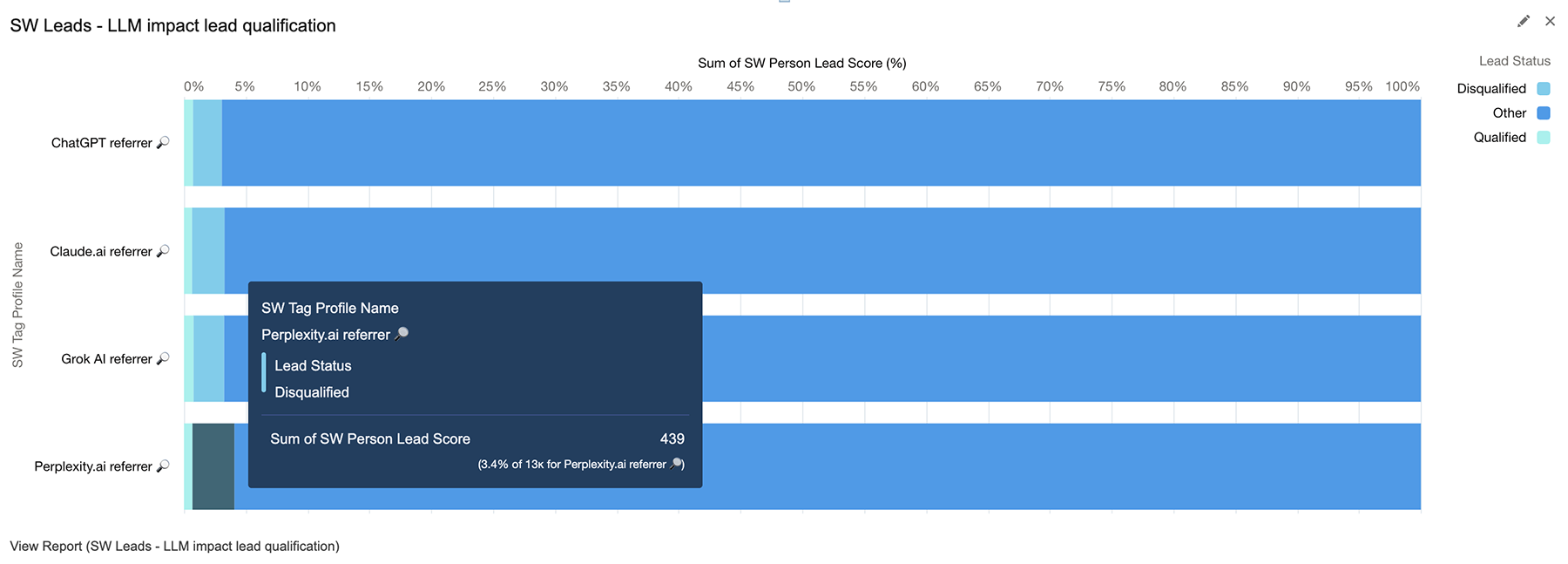
Salesforce LLM influence report on lead qualification rates
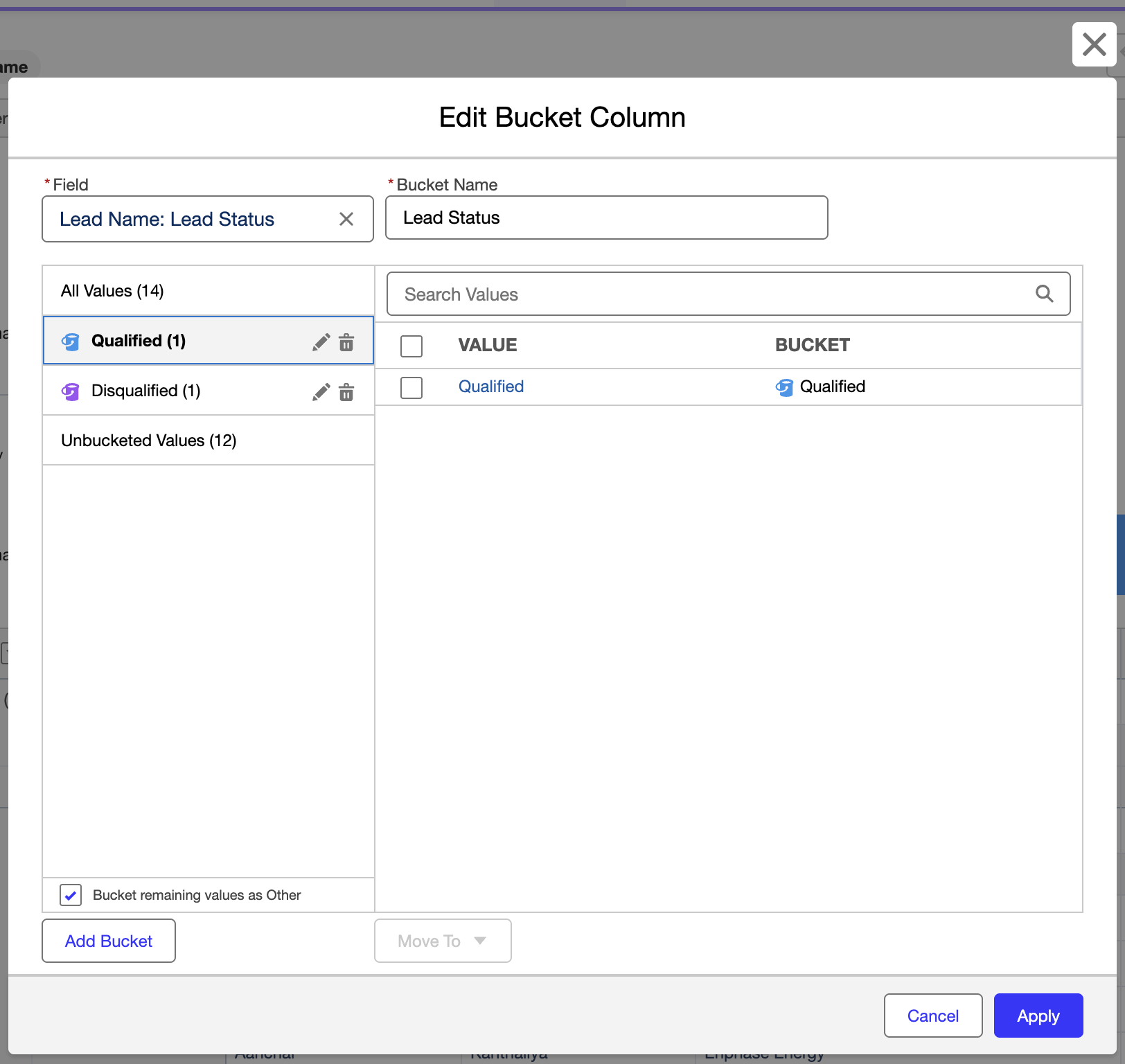
This report requires a lead report, which you first bucket by lead status. We recommend bucketing lead status’ into “Qualified”, “In progress” and “Disqualified”, logically. If you have too many values in “In progress” or want to keep it simple, just leave those unbucketed.
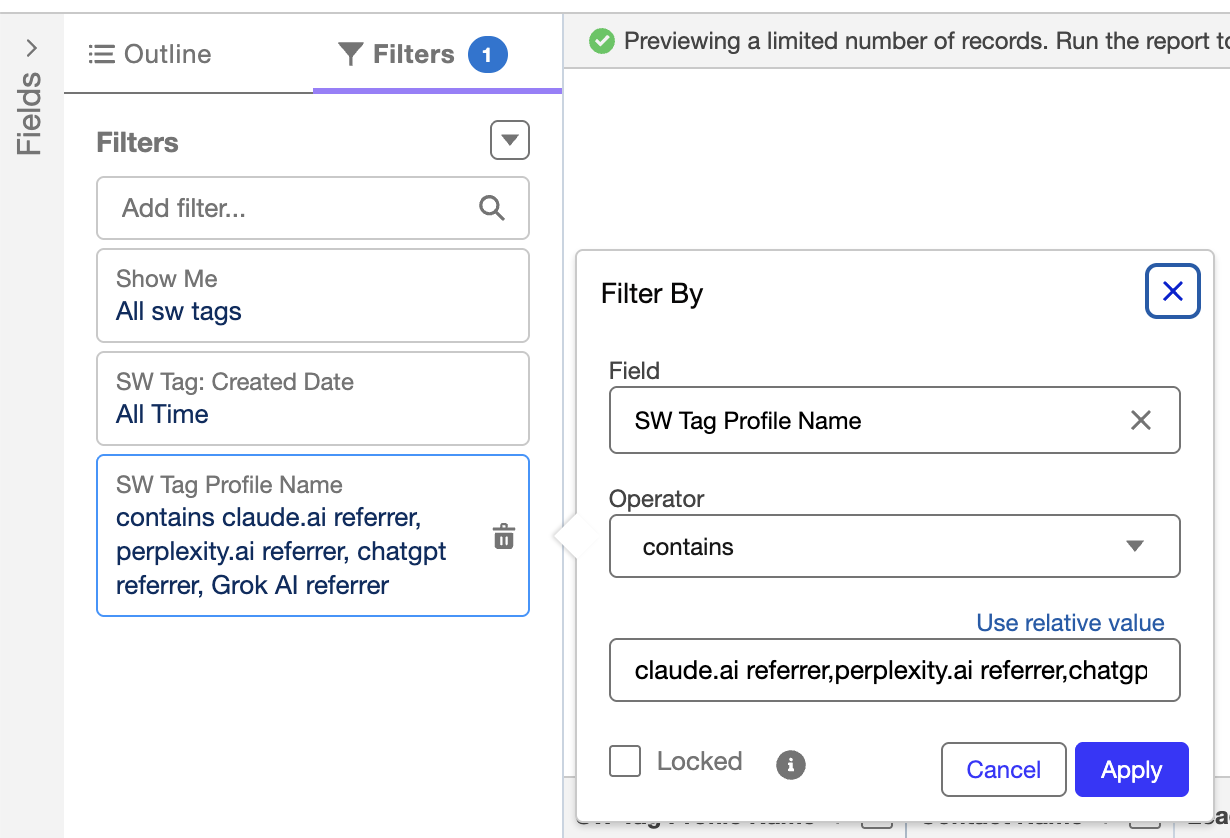
Using a solution like SalesWings will then give you the data that allows you to filter out all leads who have priorly performed a search on LLM chatbots such as Claude or ChatGPT and consequently visited your website over the course of their buying cycle, natively in Salesforce.
Lastly, you need to visualize this AIO Salesforce report on a dashboard and stack all bars to 100%. This way, you can clearly see the qualification rates (%) of leads for this subset, and compare them to your average lead qualification rates.
Salesforce LLM influence report on pipeline generation
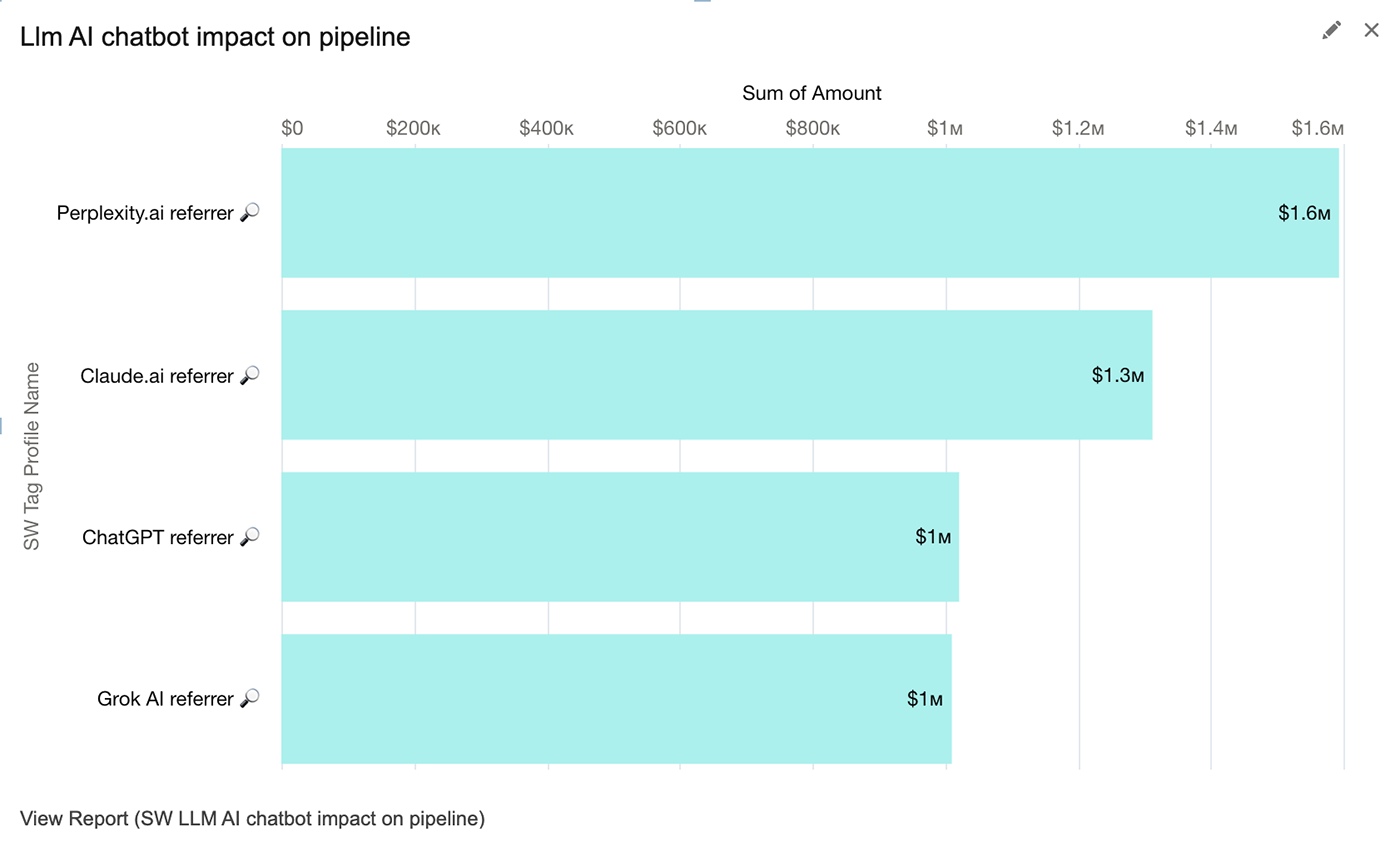
This report tries to understand how LLM search impacts the creation of opportunities for a specific time period, both net new and expansion opportunities. In this case we’re looking at accounts and opportunities. Naturally opportunities do not engage with LLMs, so we’re reporting on accounts where contacts have displayed LLM search before and then visited your website.
Person-level LLM visibility tracking tools automatically aggregate chatbot touchpoints in Salesforce on the account level, allowing you to focus on the data versus the technical implementation.
This report should include the opportunity creation date, so that you can compare the opportunity volume created for a given time interval. Next, you filter out accounts who have shown engagement on ChatGPT, Claude or Perplexity and look whether the opportunity amounts are growing over time.
Salesforce LLM influence report on opportunity close rates
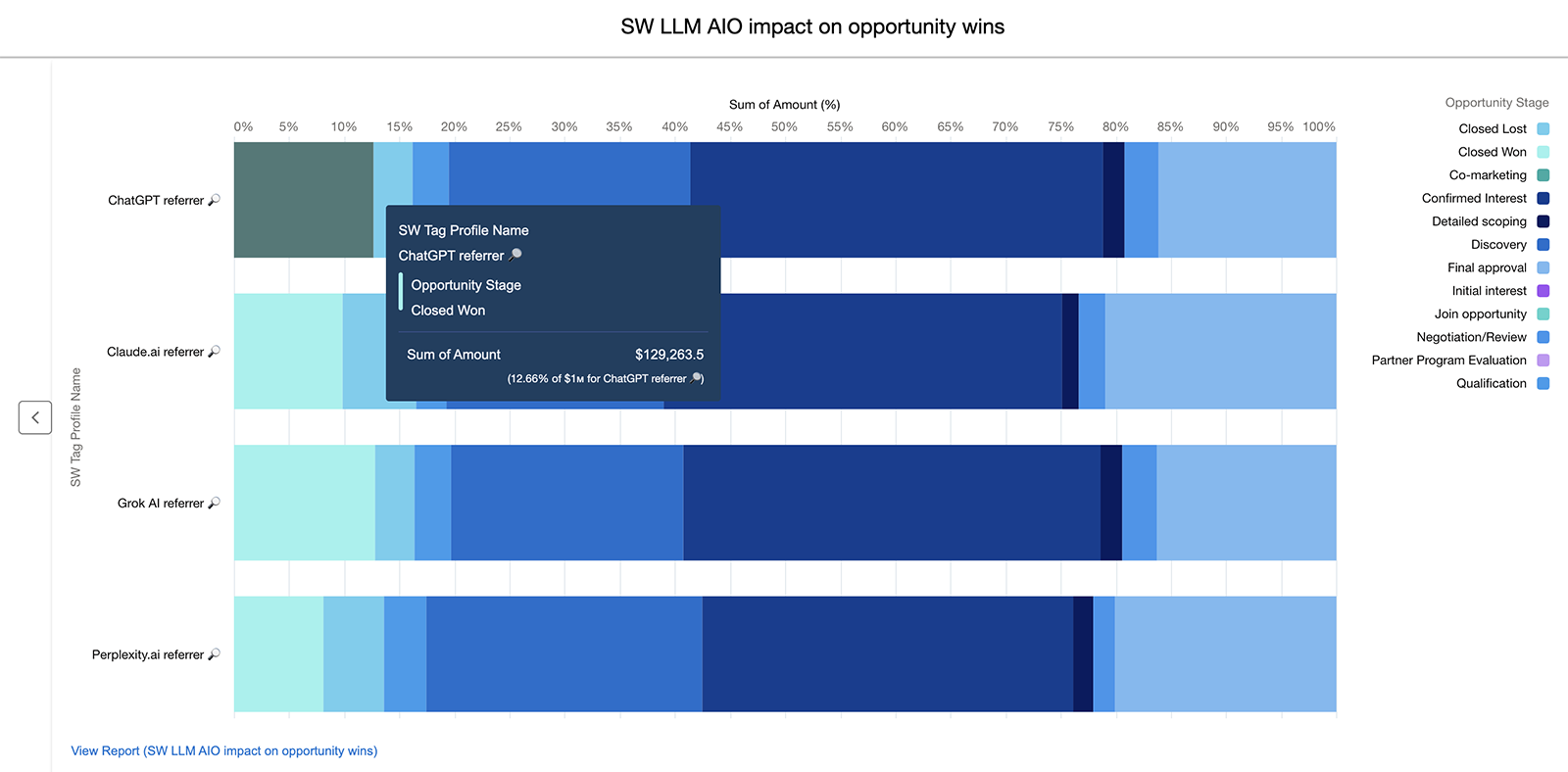
Finally it is important to understand whether opportunities that have been influenced by your AIO tactics, and AEO optimized content, have a higher win rate than the rest.
To achieve this, take an opportunity and account report, which you bucket by opportunity stages. I recommend that you bucket them into 3 buckets, similar to lead status, so “closed won”, “closed lost”, and “in-progress”.
Now you can get a few different views and graphs. For instance, you can compare opportunity win rates by LLM, if you already have significant traffic from AI chatbots. Furthermore, you can compare the overall close rate across all opportunities with the close rate of opportunities where accounts had priorly been influenced by chatbot search.
Conclusion
AIO is quickly becoming the “new SEO” in the sense that it shapes discoverability where buyers are increasingly doing their early-stage research. Amsive wrote on a recent blog post the following: “In AI search, being second place means being invisible. AI engines provide singular responses rather than multiple options. The brands that establish authority today will become the sources that AI engines consistently recommend.” (Source: amsive.com/insights/seo/answer-engine-optimization-aeo-evolving-your-seo-strategy-in-the-age-of-ai-search/)
But the real challenge for marketing operations and content marketing teams isn’t merely being mentioned on common AI chatbots like ChatGPT or Perplexity. It’s about building a process and technical solution that ties AI discovery to business outcomes in Salesforce. Purpose-built solutions like SalesWings provide for a solution to capture the behavioral signals, stitching it to leads/contacts/accounts/opportuities, and making AI touchpoints reportable in the CRM data model so that revenue teams can finally close the loop.
The teams who win here will be the ones who treat AIO like any other performance channel. Approach it properly, align internally on outcomes you want to track agains and report on it in a structured manner. With the right solution you can quantify whether AI-driven discovery improves lead acceptance, SQL rates, pipeline generation, and win rates, and then scale what works.
Frequently Asked Questions
- What’s the difference between AIO, AEO, GEO and AISO?
- AIO influence tracking: how do we tag GA4 referrals?
- AIO marketing attribution: how can Salesforce capture chatbot touchpoints?
- AIO visibility: which KPIs prove revenue impact fastest?
- AIO influence tracking: how do we link identities to accounts?
- AIO marketing attribution: what reports show pipeline lift?
- AIO visibility: how do we separate branded from net-new demand?
- AIO influence tracking: which Campaign/UTM structures work best?
- AIO marketing attribution: how often should we refresh dashboards?
What’s the difference between AIO vs. AEO vs. GEO vs. AISO?
Here’s a brief overview of some of the most common terms which are commonly used when it comes to optimizing results around AI chatbots.
| Term | Primary goal | Core tactics |
|---|---|---|
| GEO Generative Engine Optimization | Increase the likelihood your brand/content is cited, summarized, or recommended by generative AI systems. |
|
| AEO Answer Engine Optimization | Win direct answers and featured placements for specific questions. |
|
| AIO Artificial Intelligence Optimization | Optimize AI-driven workflows and outputs (quality, efficiency, governance), beyond search visibility. |
|
| AISEO / AISO AI Search Engine Optimization / AI Search Optimization | Improve visibility across classic search and AI-powered search/assistants (hybrid discovery). |
|
AIO influence tracking: how do we tag GA4 referrals?
Define an “AI referrals” rule set in GA4 using source/medium and referrer allowlists, then segment conversions and audiences based on those rules.
Build a dedicated exploration showing AI-referred sessions, landing pages, engagement, and key conversions like form submissions, demo requests or trials. Maintain a living allowlist (e.g., chat.openai.com, perplexity.ai, claude.ai) and document inclusion logic so reporting stays consistent. Create an audience for AI-referred visitors to analyze paths and micro-conversions even when UTMs are missing. Tip: publish your rule set in your RevOps runbook so teams interpret performance consistently. See GA4 traffic source dimensions.
AIO marketing attribution: how can Salesforce capture chatbot touchpoints?
Use website tracking with identity resolution and a Salesforce-native data model that writes AI touchpoints to Leads, Contacts, Accounts, and Opportunities.
Capture referrers from AI assistants, stitch them to people via form fills or email click-throughs, and roll them up to related Accounts and open Opportunities. Ensure fields and objects map cleanly to standard Salesforce reporting so influence is queryable without custom code. Tip: accelerate implementation by adopting a vendor that models AI interactions natively in Salesforce. Explore SalesWings’ Salesforce-integrated marketing attribution software.
AIO visibility: which KPIs prove revenue impact fastest?
Prioritize lead acceptance rate, MQL→SQL qualification rate, pipeline creation, and opportunity win rate segmented by prior AI chatbot engagement.
Compare cohorts influenced by AI discovery against your overall baseline to validate lift quickly. Start with a 90-day window and segment by segment (ICP, region, product) to spot where AIO has the most leverage. Visualize with stacked percent charts in Salesforce dashboards to make differences obvious for stakeholders.
Tip: set quarterly targets for each KPI and review variance alongside spend to inform scaling decisions.
AIO influence tracking: how do we link identities to accounts?
Combine first-party form detections and email click IDs with account matching rules to associate AI-referred sessions to people and the correct Account.
Detect submissions on any web form, enrich with marketing automation click-through data, and dedupe to existing Leads/Contacts. Use domain or CRM keys to attach people to Accounts, then aggregate AI touchpoints at the Account level so Opportunity influence becomes reportable.
Tip: document deterministic and heuristic matching thresholds to keep Operations and Sales aligned.
AIO marketing attribution: what reports show pipeline lift?
Build three views: lead qualification distribution by AI influence, opportunity creation over time for influenced accounts, and win-rate by influence cohort.
For leads, bucket status (Qualified/In-progress/Disqualified) and filter where prior AI engagement exists. For pipeline, report on opportunities created by accounts with influenced contacts, grouped by creation month. For revenue, compare closed-won rate across influenced versus non-influenced cohorts.
Tip: keep filters identical across dashboards so executives can compare apples to apples. Use Salesforce charts effectively.
AIO visibility: how do we separate branded from net-new demand?
Segment AI-referred visitors by landing intent and brand signals, then validate in Salesforce using first-touch and recent-touch fields at person and account levels.
In GA4, classify landings tied to category pages, comparisons, or problem statements as net-new intent, and brand-navigational pages as branded. In Salesforce, mirror the classification with Campaigns or fields to compare qualification, pipeline, and win rates by demand type.
Tip: review a monthly sample to QA the rules and refine your taxonomy. Learn GA4 landing page analysis.
AIO influence tracking: which Campaign/UTM structures work best?
Keep UTMs simple for content origin and intent, and store AI detection flags in page-level or event parameters rather than overloading UTMs.
Many AI assistants won’t pass UTMs reliably; instead, rely on referrer and server-side rules to tag “AI source.” In Salesforce, map source, content topic, and AI-influenced boolean to Campaign Members for roll-up reporting without fragmenting Campaigns.
Tip: publish a one-pager with allowed UTM values and examples for your team.
AIO marketing attribution: how often should we refresh dashboards?
Refresh operational dashboards daily for pipeline hygiene and review executive AIO influence rollups weekly, with a deeper monthly cohort analysis.
Daily updates keep sellers engaged and surface routing issues; weekly reviews align leadership on trends. A monthly cohort view (by segment, product, and region) validates sustained lift and informs budget shifts.
Tip: schedule automated emails or Slack snapshots so stakeholders see consistent context without logging in.
Author Bio
 Philip Schweizer, SalesWings CEO and Head of Product. Philip Schweizer is a co-founder at SalesWings, a leading martech platform to optimize revenue operations at every step of the funnel by leveraging behavioral intelligence in all its form. At SalesWings, he is leading AIO initiatives given its importance in 2026 and beyond. His experience encompasses designing and building marketing and sales technology stacks and operational processes, helping leading marketing and sales operations teams gain efficiency and outcomes around the processes that are at the very core of their day-to-day revenue operations.
