


This article was updated on February 19, 2026 with an up-to-date FAQ section.
Take a look at your inbox. Chances are, there are one too many unread emails sitting in it, waiting for you to read them, click them, or reply to them. As you probably already know, not all emails are made equal, and not all emails have an equal chance of you engaging with them. The harsh reality is that even if you have invested in the latest email technologies such as website tracking and lead scoring (SalesWings) or email automation (Reply.io), you will not be successful unless you respect the cold email etiquette. For instance, of all the unread emails in your inbox, you’re least likely to open the ones that are unsolicited and clearly promoting a service or product. Especially when we talk about cold emails SaaS companies send out.
According to an April 2016 Mailchimp report, cold emails from the software and web app industry have an open rate of 21.6%. That means almost 80% of the emails sent by companies selling SaaS go unread.
Why is this?
The problem with SaaS cold emails is that most of them suck.
So how can you create a cold pitch for your SaaS that will jump from the bottom to the top of a prospect’s priority list? How can your email campaign join the top 21.6% of SaaS cold emails that DO get read and better yet, the 2.4% that get clicked?
The keys to effective cold SaaS email opens are:
- Trust
- Relevancy
- Personalization
So, are you selling SaaS? Think about the last time you read and responded to an email from a stranger. What was it about the email that earned enough trust for you to open it and interact with it?
Hint: the email looked like it was written especially to you by a knowledgeable human being who offered something you specifically needed in that moment.
We’re going to break down the best ways to achieve the above-mentioned qualities for your next email outreach campaign. By the end of this post, you’ll be able to stop sounding like a robot, stop blasting your list with irrelevant spam, and and start winning clients through the careful art of cold SaaS email campaigns with a human appeal. Here is how to improve your SaaS selling techniques by crafting the perfect cold email!
Tip #1: Segment your list and then segment the segments.
Well-executed cold emails catch your eye because they include something in the message that shows that the email is relevant to a specific aspect of your life.
But how can a total stranger know what’s relevant to your life? Through research and segmentation.
According to the Conversion XL blog,
“Segmentation allows you to treat different groups of people differently.
For the practical implementation, see Behavioral Segmentation.
By sending them more personalized content, you can increase conversions. Motivations, intentions, anxieties, etc. change based on the stage of the conversion funnel, time, interests, age, gender – the list is endless.
Segmentation is what helps you stay relevant, automagically, with your ever-changing list and their ever-changing wants / needs.”
Segments can be created according to job role, hometown, membership in a Slack group, LinkedIn profiles, Twitter hashtags, use of a competitor’s product, contribution to an influential blog…the list of ways to segment can go on and on.
The point is, you need to get specific about WHO you are sending your emails to, and send your emails to the right people.
And then, after you start seeing a response, you continue to segment your prospects based on their buying behavior and interactions with your campaigns.
This process will likely take place several times over the lead group nurturing process. But your SaaS selling campaign will start off most effectively if you’ve already done the research on who your ideal prospect is and what problem your product will solve for them.
Speaking of problem-solving…
Tip #2: Tailor subject lines that speak to your prospect’s pain.
People respond to headlines that apply directly to their current pain points. If you know that the leads you’ve sourced share a very specific problem, address it as directly as possible up front where they can see it.
Check out these subject lines and tell me which one you’re more likely to open:
- #1
From: Marketing & Sales, Reply.io
Subject: Download our latest email automation app
Or
- #2
From: Oleg Campbell
Subject: will my clever little app win you more email opens?
According to Sumo Me, the reason you’ll most likely open option #2 is because it uses the following formula:
Interest = Benefit + Curiosity
The benefit: “more email opens”
The curiosity factor: “clever little app” and “?”
This formula isn’t just for email subjects, BTW. If you apply this formula to every aspect of your cold email messaging, you’ll see your response rate skyrocket.
Tip #3: Define the reason for the email.
If a stranger came to your door, would you invite them inside before you knew the reason for their visit?
I would hope not.
Cold emails can feel like an invasion of privacy if you just go into pitching your product without offering a reason why you think your prospect– as an individual— would find your prospect helpful.
Say why your company is reaching out about your particular product. Including a sentence about what that led you to find them can establish trust. It opens up the possibility of a friendly rapport (which they will then associate with your product).
Try this as an opening sentence:
“I saw on <social media platform> that you <user/segment characteristic, i.e. “run a freelancing business” or “are a fan of (competitor)> and thought our new <describe product, i.e “time-tracking app”> could help you <benefit, i.e. “create more accurate time estimates for projects.”>
Do you see how that opens the door to a conversation?
Tip #4: Speak directly about the offering.
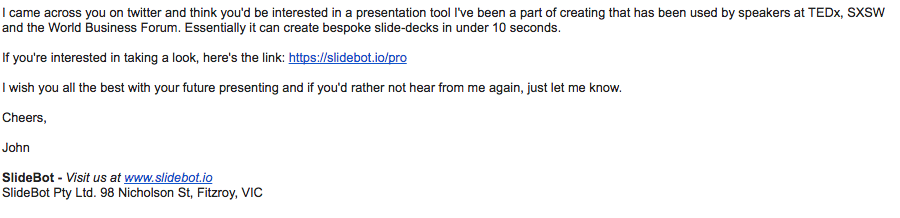
Are you confident about your SaaS sales techniques? Then you probably know that leads are most interested in what you have to offer. Mentioning the product upfront inspires trust and establishes a direct atmosphere. Here’s a cold email I received that is simple, to the point, and describes the product succinctly. In the description, you can also add a link back to your website and track the prospect by adding SalesWings. If the prospect clicks on the link, SalesWings will track it and tell you in real-time when your prospect is sales-ready.
Tip #5: Include details about direct benefits.
It goes against a lot of traditional advice, but mentioning the details about what your product does projects an aura of expertise. The above email discusses the benefit of the service–“create bespoke slide-decks in under 10 seconds”–without getting too sales pitchy.
If you’re in enterprise SaaS sales, your leads are likely busy and don’t have a lot of time to sort through email that may not be helpful to them. Being direct about what you can do for them bridges the gap between your company and a cold lead that may be interested.
Tip #6: Customize your copy so you’re addressing an individual.
When you’re using email templates, don’t just stop at the name field for personalization. You can create spreadsheets with merge fields that include anything from their geographic area to the title of their last blog post. Take a look at this email outreach template I use for contacting influencers:
Hey {First Name},
First of all, thank you for {contribution}. Your work in {industry} has help to inspire and guide us in the creation of our company.
As you know, {mention current condition in market that makes your solution necessary (1 sentence)}.
This problem led us to create {Company Name & Link}, a {Product Description} app that {Benefit}.
Since you often review {type of product}, we’d love to see if you think we’re on the right track. Would you be interested trying out a beta version?
Again, thanks so much for your continued contributions to (industry}. If you can use any help with future endeavors, don’t hesitate to reach out.
Cheers,
{Name}
{Role}
{Company, link}
{Phone}
P.S. If you like what you see and want to let more people know, {invite them to sign up for referral campaign with link}.
Phrase your SaaS selling offering in terms of what will serve the individual recipient for the most effective response. Will it help them with day to day tasks? Does it enable better communication between them and their peers? Start by directly targeting their needs in the moment and then broaden out to benefits relevant to the group.
Tip #7: Eliminate unnecessary copy.
This is one tip that applies to every step of the SaaS cold email process and can be applied to supplement every tip on this list. A cold email must be effective precisely because it may be the first interaction this lead may have ever had with your company. You need to make a good impression!
If you’re selling SaaS software, shorter emails also narrow the chances of customers dropping off or feeling pestered. It is less of a mental burden on the customer to read five sentences from an unknown company than five paragraphs.
Tip #8: Space out emails sent to the same lead types.
Junk mail filters loooove to gobble up mass emails. If you’re sending a cold email to people who work at the same company or have the same email suffix (i.e. @gmail.com), be careful of blasting too many emails simultaneously. Your best bet is to stagger the amount of emails you send in any given time slot.
Tip #9: Deliver useful and different information with every nurturing email.
Repetitive sales emails are rarely effective. If there’s no response to an email, there’s always a reason.
Treat your email campaign like a journey: what’s the desired outcome for your campaign? A click? A response? A meeting?
Then identify at what point your prospect is in their journey toward that outcome: you’ve already introduced yourself, so what’s something else they might find interesting about your product? What’s something else you can help them with? Lead nurturing is the art of guiding a prospect to the “A-ha” moment when they realize exactly how your product will fit into their life.
There’s another practical aspect to creating lead nurturing content:
Changing the copy to highlight different aspects of the product allows for leads to survey and better assess the product over time. Open rates varying by messaging may allow you to divide and specialize leads according to interest. That’s valuable data!
Tip #10: Stay the course.
It can get discouraging to send emails out regularly with very little response. But here’s some advice: don’t be part of the 92% of people who give up after four followups.
Your leads may not have heard the most relevant product detail or hit the right budget allotment within their company to afford your product. Keep nurturing your leads as long as they remain relevant and suitable to your product.
Email software like Reply.io can help you create personalized, segmented cold email campaigns, and will immediately place each lead into a different segment once you get a response. So you can ensure your SaaS stays top-of-mind and converts like crazy.
Persistence pays off!
Do you have more tips to contribute?
Share your best advice in turning cold emails into SaaS sales in the comments!
Frequently Asked Questions
- How should I segment my cold email lists?
- What details matter most when personalizing cold emails?
- Do templates or highly personalized emails convert better?
- What cold email subject lines actually work?
- How can I automate personalization at scale?
- How many follow-ups should I aim for in my cadence?
- How can I avoid my emails landing in prospects’ spam folders?
How should I segment my cold email lists?
Segment by role, industry, tech stack, trigger events, and engagement so every message aligns with a concrete pain and next step.
Start with firmographics (company size, industry) and buyer roles, then layer in product usage proxies such as competitor tools or relevant integrations. Create micro-segments around timely triggers (funding, hiring, tech migrations) and split by behavior after each touch to refine offers. By keeping fields lightweight, reps can update them quickly; document rules to keep segments clean over time.
Tip: End each email with a simple yes/no question to funnel replies and learn faster.
Do templates or highly personalized emails convert better?
Templates set the frame, but a single tailored insight consistently lifts replies far more than extra length or fluff.
Use a proven skeleton (problem, outcome, proof, next step) but require one sentence that proves you did real research. Replace generic social proof with a peer-relevant example and quantify the before/after when possible. If replies stall, tighten the copy and test a shorter version before changing the offer; brevity helps busy prospects decide quickly.
Tip: For writing examples and fixes you can adapt, see this breakdown of common mistakes.
What details matter most when personalizing cold emails?
Use one crisp problem insight tied to their world, then map your value to that single, verifiable detail.
Go beyond {First Name}: reference a relevant metric, workflow, or recent change like a new tool adoption, hiring for a related role, or a public KPI. Mirror their terminology and keep the personalized line above the fold so it’s seen on mobile. Avoid flattery and trivia; prioritize signals that imply urgency or ownership of the problem.
Tip: Read our article about long versus short emails and when to use them.
What cold email subject lines actually work?
Lead with the prospect’s outcome in 3-6 words, add curiosity or specificity, and avoid spammy capitalization or punctuation.
Test structures such as “{team}’s {metric} without {pain},” “Quick idea for {tool/stack},” or “Cut {process} by {time%}.” Personalize lightly when it’s meaningful (role, tool, or initiative), and keep the tone human; lowercase often feels conversational. Make the preview text earn the open by extending the benefit, not repeating the subject.
Tip: Try two to three variants per segment and retire underperformers quickly to protect deliverability.
How can I automate personalization at scale?
Templatize the structure, not the insight: merge fields handle context while reps add one custom line that anchors the pitch.
Build a modular template with slots for pain, proof, and next step; preload dynamic fields from your CRM (industry, tool, trigger). Use snippets for common pains per persona, and require a human-written opener that references a recent signal. You can track click and visit intent so sequences branch automatically when interest spikes; tools like SalesWings help you prioritize replies in real time.
Tip: Include a clear fallback when data is missing to avoid awkward blanks.
How many follow-ups should aim for in my cadence?
Plan 5-8 touches over 12-18 business days, varying angles and media while respecting signals to slow or stop.
Start with a concise, value-led email, then alternate problem reframes, proof points, and a short case snippet. Then, thread replies to maintain context and shorten each follow-up. Next, you can shift the CTA from “meeting” to “quick confirmation” or “resource share” if there’s no response by touch three. Lastly, pause when you see strong negative signals, and recycle into a later campaign with a fresh trigger.
Tip: Keep a living playbook so the team iterates based on reply buckets and booked meetings.
How can I avoid my emails landing in prospects’ spam folders?
Respect consent laws, maintain list hygiene, and send helpful, relevant messages that match your subject and signature details.
Include accurate sender information, a physical mailing address where required, and a clear opt-out. Avoid deceptive subjects, heavy images, and link trackers on every line; one tracked link is usually enough. By warming up new domains and space sends to similar domains, you’ll reduce the amount of filtering required. Most importantly, write like a human to a human: clear value and relevance drive positive engagement signals that boost inbox placement.
Tip: If uncertain, ask legal to validate your template and cadence before large sends.

About the Author: Lucy Literado is VP of Marketing at Reply.io. Reply is inbound and outbound sales automation platform that puts your outreach on autopilot still keeps it personal
Schedule a demo with Philip if you would like your sales team to close more deals by using our website and lead scoring tracking.

We thought you might be interested in this article:
