


This article was updated on December 15, 2025 with an up-to-date FAQ section.
We all agree that time is money. So we need to optimize it very carefully using the right process. We all need to develop our business, increasing our turnover each year and not only finding new customers but retaining them. In order to do so, we need to invest in sales automation tools and methodologies like Outbound sales created by Datananas or SalesWings which helps your company track your leads and score their level of engagement
The traditional Marketing & Sales team roles and their limits
Let’s start with the Marketing team, which generates a considerable amount of leads – although not necessarily qualified leads – through different marketing strategies. You have probably heard of Inbound Marketing to bring relevant content to your prospects, as well as the classics: exhibitions, sponsorships, company website, webinars, and so on.
To sort leads and focus your Sales team only on the most sales-ready, tools such as SalesWings help you score your leads upstream so that you know where to invest your time and energy without wasting either. Thus, you will be able to focus exclusively on the right leads, i.e. hot leads.
However, in this configuration, the Sales team plays only a passive role, awaiting qualified leads from Marketing. Once leads are generated, the Marketing team will qualify them and the Sales team will convert them into clients.
The new lead generation process where Sales and Marketing work together
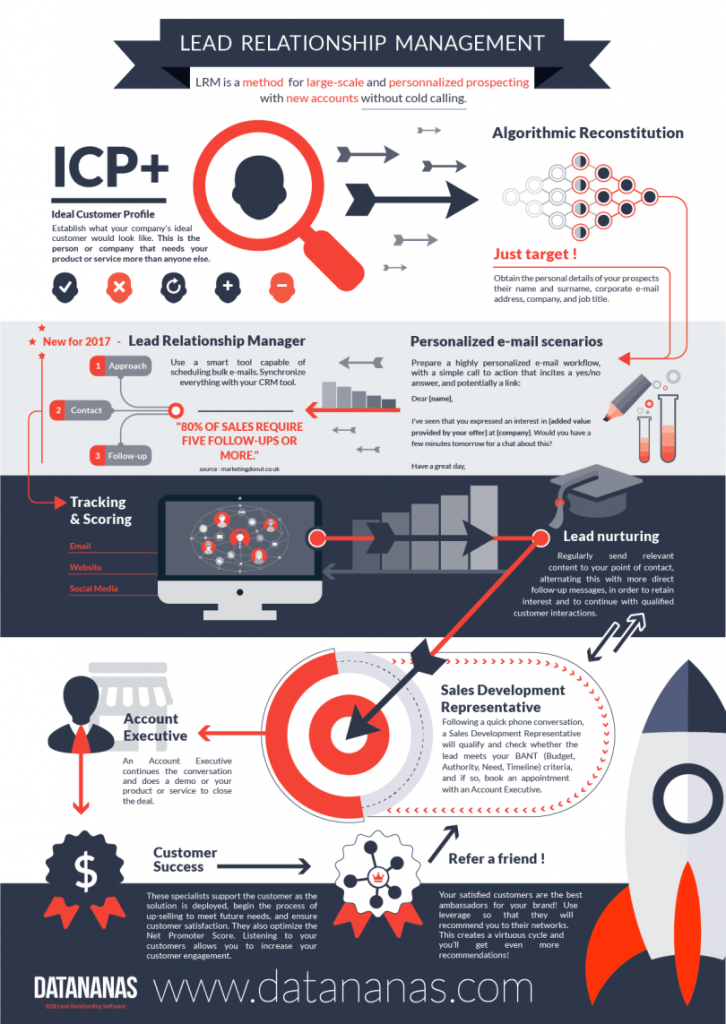
Today, Sales teams can play a major and proactive role in the lead generation process by using the latest cold sales development techniques, known as the Lead Relationship Management methodology or Outbound Sales.
Using this approach, and after defining the Ideal Customer Profile, the Sales team sends out a highly targeted, personalized and automated email campaign. The success of this method lies in the follow up! Indeed, 80% of sales occur after 5 follow-ups! To avoid doing these follow-ups manually, some platforms such as Datananas help manage these for you and automatically stop email follow-ups once they detect a prospect response.
A lead-generation-driven Sales team
In a modern-day Sales team, Sales Development Representatives (SDRs) manage the lead flow. In Sales teams of a certain size, some representatives are even specialized in managing inbound or outbound leads flows. Their job is to qualify the leads and then transfer them to the Account Executive with all the necessary details to forge a relationship and close the deal.
If the Account Executive decides that the prospect is not hot enough, then the prospect will receive lead nurturing campaigns through marketing contents such as infographics, video, blog articles, etc., which are always interesting for your prospects. These should give advice or information regarding their daily needs.
At some point, your Account Executive will be able to close deal!
Last but not least, have your Customer Success team take the lead in order to retain clients and offer a great customer experience for your product or service. The hardest part is not gaining new clients, it’s keeping them. Make sure to build a strong and sustainable customer relationship.
Check out the infographic summarizing the Lead Relationship Management process
Frequently Asked Questions
- How can I pick the right prospecting tools?
- How should sales ops leaders partner with marketing?
- What best practices should I employ for follow-up cadences?
- Which definitions and SLAs matter most?
- How should we use lead scoring as part of our sales & marketing alignment strategy?
- Which sales automation tools should SDRs initially use?
- How do I build ICPs and routing rules?
- How can I measure “qualified lead” impact?
How can I pick the right prospecting tools?
Score tools against your motion (channels, volume, integrations, governance) and run time-boxed pilots with clear “go/no-go” success criteria.
Evaluate deliverability, personalization depth, data compliance, and reporting; confirm CRM write-back and role-based permissions before contracts. Negotiate proof-of-value tied to real meetings and ensure admin workload stays manageable for Sales Ops.
Tip: maintain a living tool matrix so new vendors are compared on apples-to-apples metrics.
How should sales ops leaders partner with marketing?
Start by aligning on shared pipeline targets, common funnel definitions, and a closed-loop feedback cadence that continuously tunes targeting, messaging, and routing.
Sales Operations can broker a single source of truth across CRM, MAP, and sequencing tools, define handoff checkpoints (MQL → SQL → Opportunity), and enforce enablement readiness before campaigns launch. Weekly win/loss and “no-show” analyses help marketing refine ICP hypotheses while SDR leaders adjust scripts and channels. Document it all in a revenue playbook with owners and SLAs so improvements persist beyond a single quarter.
Tip: co-own a joint dashboard that tracks stage conversion and time-to-first-touch within 24 hours.
What best practices should I employ for follow-up cadences?
Use a multi-channel sequence of several touches over 2-3 weeks, combining email, phone, and LinkedIn, and keep value front-and-center.
Research on top-performing prospecting shows that multiple, consistent attempts materially increase connection and meeting rates; mix formats (short emails, voicemail, social comments) and vary value props, not just subject lines. Standardize touch spacing (e.g., day 1, 3, 5, 8, 12, 16) and stop on positive replies or disqualifying signals. Capture reply reasons to refine messaging fast.
Tip: audit sequences monthly; retire steps with below-median reply rates and A/B new openings.
Which definitions and SLAs matter most?
Agree on precise MQL/SQL criteria, response-time SLAs, accepted disposition reasons, and a two-way recycle path before launching any campaign.
Define qualification thresholds (fit + intent signals), owner at each stage, and timing expectations; for example, SDR first-touch within 24 hours and two additional touches within five business days. Require documented outcomes (e.g., Not ICP, No Need, Timing, Competitor) to inform future targeting and content. Ideally you’ll establsih a monthly governance meeting as well to adjust scoring weights, forms, and routing as markets shift.
Tip: publish the definitions inside CRM so reps see them at the point of work.
How should we use lead scoring as part of our sales & marketing alignment strategy?
Blend fit scoring (ICP attributes) with behavioral scoring (intent signals), and calibrate thresholds against downstream opportunity creation, not just MQL volume.
Weight firmographics (industry, size, tech stack) and buying roles, then add actions that correlate with meetings booked (e.g., pricing views, product pages, high-intent content). You’ll then want to run backtests on won/lost opportunities to tune cutoffs and avoid flooding SDRs with low-intent names. It’s important to keep scoring transparent for reps, and pair points with clear next steps (route, nurture, or disqualify).
Tip: review score drift quarterly and re-map behaviors as your product and content evolve.
Which sales automation tools should SDRs initially use?
Prioritize sequencing, tracking, and intent. Choose tools that automate follow-ups, surface hot accounts, and integrate cleanly with your CRM.
Start with an email/omni-channel sequencer, enable automatic pause on reply, and feed interactions back to dashboards Sales Ops controls. You can add website intent tracking to reveal engaged contacts and prioritize call blocks. Integration depth and data governance matter more than feature lists; avoid shadow systems that fragment reporting.
Tip: pilot with one squad and a clear success metric like “meetings per 100 contacts.”
How do I build ICPs and routing rules?
Define an Ideal Customer Profile using firmographic, technographic, and trigger criteria, then route by territory, segment, and buying role for speed.
Use historical win data to identify common traits (industry, employee bands, tools used) and negative indicators. Moreover, it’s possible to pair rules with enrichment to avoid manual work and set exceptions for strategic accounts. Keep marketing forms aligned to capture routing-critical fields without hurting conversion.
Tip: document “borderline” scenarios so SDRs know when to qualify versus recycle to nurture.
Outbound sales & lead generation: how do we measure “qualified lead” impact?
Track stage-to-stage conversion, time-to-first-touch, meetings-per-lead, and sourced pipeline (not just lead volume) to prove contribution.
Build a shared dashboard by campaign, segment, and SDR squad; include recycled reasons and meeting no-show rates to highlight quality issues early. You can also use cohort analysis to compare sequence variants and content offers. Present quarterly readouts that connect qualified leads to opportunities and revenue, with lessons learned and next experiments.
Tip: standardize definitions across tools before reporting to leadership.
About the Author:

Serial entrepreneur, Arthur Ollier is not on his first trial. Since the very beginning, he has to face 2.0 prospecting issues. He is the Sales and Financial Manager at Datananas. He conceives, undertakes and recommends the LRM methodology in order to make the outbound prospecting actions predictable.
We thought you might be interested in this article…
> The 3-Step Guide to Implementing Predictive B2B Sales & Marketing Tactics
